Showing posts with label Saturday Evening Post. Show all posts

Saturday, July 30, 2011

The House of the Venerable and Inscrutable Colonel

Really, It’s Just KFC.

In general terms, this post is just a celebration of Neal Stephenson’s mastery with words and the fun he has with thunderous incongruities. I’m going to do that in two ways—both from The Diamond Age.


First, I want to place the utter centrality of Kentucky Fried Chicken in Shanghai, several decades into our future. Judge Fang, Constable Chang, and Miss Pao are the participants in this spoof. They are trying a little boy named Harvard for assaulting a rich young engineer and stealing some of his possessions. Up to this point the trial has been conducted in English.
At this point, the three revert to Chinese.

“The hour of noon has passed,” said Judge Fang. “Let us go and get some Kentucky Fried Chicken.”

“As you wish, Judge Fang,” said Chang.

“As you wish, Judge Fang,” said Miss Pao.

Judge Fang switched back to English. “Your case is very serious,” he said to the boy. “We will go and consult the ancient authorities. You will wait here until we return.”
The House of the Venerable and Inscrutable Colonel was what they called it when they were speaking Chinese. “Venerable” because of his goatee, white as the dogwood blossom, a badge of unimpeachable credibility in Confucian eyes. “Inscrutable” because he had gone to his grave without divulging the Secret of the Eleven Herbs and Spices.


I think I have not passed a KFC for a decade or more without some version of the “House of the Venerable and Unscrutable Colonel” passing through my mind.

Today’s second celebration of Neal Stephenson will be made up of my notes on some of the words he introduced me to. I’ll pick my favorite five for today. I give Stephenson’s use first; then whatever I have come up with as the meaning.

7. coenobitical
Page 25: There were a bunch of coenobitical phyles—religious tribes—that took people of all races, but most of they weren’t very powerful and didn’t have turf in the Leased Territories.
This isn’t as weird as it looks. The dictionary cites cenobite, which solves the oe- problem and getting from cenobite to cenobitical is a short trip. A cenobite is a member of a religious order living in a monastery or convent. This distinguishes them from anchorites, who were hermits. Cenobite is a version of the Greek koinos, “common” and bios, “life.” There are later forms, of course, such as the Late Latin coenobium, “a cloister.” The prefix is pronounced SEE-no, as in evil.
9. coarcted
Page 30: All the other thetes, coarcted into their tacky little claves belonging to their synthetic phyles, turning up their own mediatrons to drown out the Senderos…
This is an unfamiliar word that really adds something. It is just right. The meaning of the adjective coarctate in biology is “compressed or constricted” or “rigidly enclosed in the last larval skin: said of certain insect pupae.” Stephenson, with the verb coarcted gets not only the cramming together but the insect image as well. “Crammed together as tight as the final skin on a larva” is the clout he gets out of this word.
7. phyles
Phyle (Greek φυλή phulē, "clan, race, people", derived from ancient Greek φύεσθαι "to descend, to originate") is an ancient Greek term for clan or tribe. They were usually ruled by a basileus. Some of them can be classified by their geographic location: the Geleontes, the Argadeis, the Hopletes, and the Agikoreis, in Ionia ; the Hylleans, the Pamphyles, the Dymanes, in the Dorian region. [Wikipedia]
41. decussating
Page 341: The unmarked decussating paths would have been confusing to anyone but a native.
Decussating paths cross in the form of an X. How that’s different from an ordinary intersection, I’m not sure. The Latin is decis, “10.” That’s 10 as in X, since it’s a Roman numeral. Decussare means “to cross in the form of an X,” which is, apparently, what “decussating paths” do.
33. glacis
Page 258: “…who would struggle their way up the vast glacis separating wage slaves from Equity Participants.”
I am shocked to find that this word is pronounced like “glasses,” except the final s- is also sibilant. It looks so French. A glacis is a gradually slope. It doesn’t have any particular temperature, although it shares the root of the Latin glacialis, “frozen.” I think it’s the connotation he wants. A glacis can be part of a fortress; the embankment sloping gradually up to a fortification so that anyone attacking it will be exposed to gunfire the whole way. I think that’s the picture he wants us to have of wage slaves trying to become Equity Participants.


Saturday, July 16, 2011

One -cize Fits All

As a regular part of our reading and listening and speaking, we blow by the most amazing caches of information. As a practical matter, we would all agree that the price of attending to this is that we are forced to ignore that. And that and that and that. That is most often just the right thing to do. If you can’t hold an intention in mind and screen out “distracting” information, you probably can’t work effectively. On the other hand, it is good to take a look, now and again, at what you are passing by.

I want to think about what we mean when we say that something has been “politicized.” Let’s start with “personalized” greeting cards. First there were greetings that I sent to you. Then there were “depersonalized” cards. These cards were commercially available and, because they had been depersonalized, cheap to produce. “Personalized cards” say “Happy graduation, dear daughter” or “Peace on Earth from Our Family to Yours.” The question these cards pass over is this: what were they before they were “personalized?” To answer that, you need to have a word that fits into a question like this one. “No, this batch hasn’t been personalized yet; they are still just __________________.”

It’s a little bit of a puzzle. I used to run without socks. I liked the feel of my foot in the shoe. Then, when I had to wear an orthotic, I had to wear a sock on that foot. But, since I still didn’t like socks, I didn’t wear one on the other foot. Friends would rag me about it sometimes. “Look” they would call, “ You have one sock on and one sock off.” If I was running well at the time, I just smiled and waved and kept on running. If I needed a break, I would stop and try to carry the topic a little further. “Well,” would say, “you are right when you say I am wearing only one sock. But when you raise the question of how many socks I am not wearing, you have moved into one of the dark regions of philosophy.” Generally, that was long enough to catch my breath, and I went on down the road—usually, not being chased by angry villagers.

No one likes to have something “politicized.” If you like opening a question to the preferences of all the people who will be affected by the decision, you call it something else. Accountability? Democracy? Neighborliness? Most commonly, we call it “the way it should have been done.”
It should have been done by the bureaucrats who, after all, know how to write rules that don’t contradict themselves. It should have been done by the judges who, after all, know what the Constitution says. It should have been done by the President and the Speaker in a private meeting. The All Stars in the recent, hugely underwatched Major League All Star game should have been chosen by the managers, not the fans.

Why does everything have to be “politicized?”

I think there’s a pretty good set of answers to that question, but they are legion and they are long. Here, I will content myself with pointing out that the virtue of the “politicize” charge is that is passes over the question of what it was—what was the decision rule—before it was “-cized.”

Saturday, July 9, 2011

Learning From Mistakes

Learning is always a good idea, but I'm not sure we learn more from our mistakes than we do from our successes. I think it might be better to say that we learn different things.

During the terms I teach at Portland State, I show up at the transit center to take the express bus (#94) to the university. By that time in the morning, I might or might not have had my coffee. For that reason, I have sometimes taken the #64 bus instead. That "take" is a "mis-take." What did I learn? I learned that if the bus goes out of the center and turns left, I should get off as soon as possible. If it turns right, I probably won't even notice it because I expected it to turn right and I am already deep into my New York Times by then.

So taking the #94 when I intended to take the #94 is not a "mis-take." It is a success. What do I learn from it? Smaller things, I think. I learn, for instance, whether at that hour of the morning the #12 bus, which follows the same route but stops for anyone who is headed downtown, is much slower than the #94. That's worth knowing, because there are a lot more #12s than there are #94s. I learn whether at that hour the express bus is more or less crowded than the 12; whether the lights are on during the trip or not; whether the group of commuters who are always talking about something in a spirited way, are still talking to each other.

It might be better, then, to say that we learn big things--you're going the wrong way--from our mistakes and little things--it's only five minutes slower and they leave the lights on--from our successes. If you are interested in learning as much as you can about the way you want to go, I'd think that successes would be preferable. They are often less painful as well, which is another reason to choose them.

And finally, two of my three children were mistakes--well, unscheduled arrivals--and I have learned at least as much as I have from the one we had on purpose.

Saturday, July 2, 2011

When the Light Comes On

There are so many physical feelings we have no names for at all. What does the interim feel like between the time you stub your toe and the time it starts to hurt? What is the feeling you get just before a muscle begins to cramp? What’s a good name for the way the oak flavor of a red wine differs from the last little burn of the tannins?

I have some mental events I’d like to have names for. What do you call it when you almost remember something? What is the little signal you get when you might have reversed the digits in a number and you have to look to be sure?

Since I like puns, one of my favorite “mental events” has to do with available meanings. Since this matters to me, I have had to call it something. I have invented a way to describe this event. I don’t know what relationship it has to the actual mental event. They both have a sequence, I guess. One thing comes before another. One thing predicts another. That’s probably all.


I call it a red light. I think I have in mind something like the “Check Engine” light on a car dashboard. Something like this picture, but without the speedometer. The value of it is that I can tell when it is on and when it is not. If it is on, the word I will need at the end of the sentence—the word that will hijack the meaning the sentence would otherwise have had—will be there by the time I get to the end of the sentence. There is nothing about this light coming on that tells me what the word is. The light tells me that it will be there when I need it.

Over the years, I have come to trust it. I don’t remember that it has ever disappointed me. Still, I do feel the tension of it. I have to overcome something to keep myself lurching toward the end of the sentence without knowing what the word is. I remember dealing myself into a conversation about fishing, for instance. I didn’t know when I started that I was going to borrow the “unreasonable sturgeon seizure” clause of the Fourth Amendment to talk about fishing. I just headed down the path, knowing something would be there for me at the end of it, and when I got there, I heard “unreasonable sturgeon seizure” at the same time everyone else did. It felt like hearing a joke told by someone else.

I haven’t ever had an “out of body experience.” This mysterious red light is likely as close as I am going to get. Still, it’s pleasant. It may very well be unique. After all these years I do trust it. Part of that trust, I am sure, comes from the fact that I have no control over it at all. I don’t know what it is. I don’t know when it will come on. I don’t know whether it will be a witty or an atrocious pun.

But when the red light comes on, Ihave faith.

Saturday, June 18, 2011

Sounding Smart

It's not all bad, I suppose. Everyone wants to be liked and included. Or, as my grad school mentor, Jim Davies says, to be a part. And everyone wants to be looked up to and admired as having a little something extra. Or, as Davies says, to be apart. So we say the quirky little things that our linguistic tribe says, the tribe to which we belong or the tribe to which we aspire.


But even so, there's a right way and a wrong way. I'm thinking of the suffix -centric. The practice of using -centered, on the one hand and -centric on the other was so routine that it never occurred to me to formulate a rule about it. You said "human-centered" if that was the expression that fit best and anthropocentric if that worked best.


If there were a rule--and there probably is--it would be that if you want to use -centric, use the Greek or Latin root from which the English word is derived and slap the suffix onto it. If you want to use -centered, use the current English form. So you might talk about an Anglocentric alliance, for example or an English-centered alliance. You would never, ever, under any circumstances, refer to an English-centric alliance. If that language is a way of aspiring to a tribe defined by careful language use, I can guarantee you that it won't work very well.


My guess is that -centric sounds smart. And you know what it means. So you just slap it on. For now, I think any reader who is used to careful use of language just rolls his eyes when, in the middle of a column about the psychiatric world view, the word "penis-centric" shows up. My concern is that if people keep doing it, it will be accepted as appropriate and the mixture of language traditions in English will proceed apace.


It will become a fait accomplished. My advice--unsought, as usual--is, if you don't know the root, just say it in English.

Saturday, June 11, 2011

Context is Everything

Don’t leave home without it.

This is a brief reflection on a movie I like very much. None of the critics shared my feelings, it seems, but I reserve the right to admit I like things that only a simpleminded person would like. This is The Joneses, starring David Duchovny and Demi Moore.

The plot, in brief, is that Steve and Kate (that’s Duchovny and Moore) are pretending to be husband and wife and parents to two perfect kids. It’s a stealth marketing scheme. The idea is that this perfect family—the Joneses—have a lot of toys and you too, if you buy all those toys, can be perfect. And, if you are Mr. Jones, you can have the perfect toy as your wife. That is the dialogue underlying this scene,


What nobody seems to have foreseen is the possibility that Steve might really fall for Kate. Not just take advantage of pretending to be her husband, but actually want a real relationship with her. That is just what happens, though. And no sooner has Steve realized that this is the woman he wants to spend the rest of his life with than he realizes that the demands of pretending to be “the Joneses” will prevent him from doing that. They can’t really be husband and wife while they are pretending to be Mr. and Mrs. Jones.


That’s the first horn of the dilemma. The second horn is that this “family” works for an outfit called LifeImage and KC (Lauren Hutton) works for LifeImage. Her job is to see to it that the Joneses and all the other families she supervises reach their potential as marketers of a certain style of life and all the toys that are necessary to sustain it. KC thinks Steve Jones really hasn’t focused the way he should, so she gives him a pep talk.


This is the point where context is so important. Had KC realized that Steve had fallen or would fall so hard for Kate, she would never have said this: “The question you have to ask is, “How far are you willing to go to get what you want?” She assumes that “what he wants” is going to be the money and the reputation that goes with being the top salesman for LifeImage.


In fact, what Steve wants is Kate. And when he has grasped the meaning of the question—How far are you willing to go?—he wrecks the whole family by telling all to the neighbors. Kate and “the kids” escape and set up another Jones family with a new Mr. Jones. But Steve finds them and comes in the back door for a heart to heart talk with Kate. After which, she leaves LifeImage as well and the two of them drive off together into the sunset.


Had KC known what Steve really wanted, she would no doubt have found a different motivational question to ask him. You really have to get the context right because, you know, it’s everything.

Saturday, June 4, 2011

The Web of Technology, Stranded

Today I had an experience that started me to thinking. I took a trip into unfamiliar territory west of Portland—if you don’t go there every week, there are always houses in places there were none the last time you were there. So just as a precaution, I cranked up the little navigation app on my Droid phone. This picture represents several steps up, but I don't have a picture of me using my Droid to navigate, so it will have to do.


Now Bette does most of my navigating and I like that best because she has a really pretty voice—that is, by the way, the first thing I ever learned about her by experiencing it—but Bette is off doing something today. The voice on my Droid (there’s no reason not to call her Anne, I guess) isn’t very nice. It has a harsh mechanical diction to it. On the other hand, Anne gives directions EXACTLY the way I like to get them from someone I can’t ask any further questions.


Anne says, “Turn left on Oleson Road (which she pronounces correctly, with only two syllables) in one mile.” When I get close, she says, “Turn left on Oleson Road and continue on Oleson Road for point seven miles.” She even says “Stay to the right” and “Take the right fork” and other more sophisticated things. Although she is only a Droid app, she’s really good.

But then I got to noticing something. When I am finding my way to a place I haven’t visited before, I pay attention to everything. That’s not a program or a plan; it’s just what I do. Without thinking about it, I notice the road signs—not just the ones that describe where I am going—but all the ones that assure me everything is where it ought to be. I’m going to Bethany Center so Beaverton ought to be over there (and it is) and Hillsboro ought to be out there (and it is) and all is well. I notice where the sun is; or, it’s May in Oregon, where it brightest part of the clouds is. I notice how much water is on the pavement. I notice whether there are Red-winged Blackbirds in that patch of cattails. I probably shouldn’t, but I do. I notice whether I am coming to a commercial area or into a school zone.

Driving with Anne, I notice less of all those. Or I did today. Why?

Well, nothing against her. Her job is to know where I am, where I am going, and what my options are along the way. She does that. On the other hand, she gives me a lot of superfluous guidance, as I noted above. She doesn’t break in to reassure me that I am still on Oleson Road, as if I were concerned that I had wandered away, but she does things that are almost like that. She provides a web made up of anticipation, specific instruction, and next step instruction and I rely on that web. When I don’t have her, I rely on a web of my own making, which comprises the distances to cities whose locations I know, attention to the road surface, attention to the driving implications of the area, like a school zone, and so on.

So, it’s my web or hers. I really think mine is better. I also think it is better for me to be constructing one than to be receiving one. On the other hand, hers is so specific and it is hard not to confuse specificity with accuracy. Digital watches always LOOK more accurate than analog watches. And the regular anticipation and followup—anticipate the turn, make the turn, here’s what’s next—is almost liturgical. It’s very soothing.

On the other hand, I have little fragments of other contexts that attach to this experience and that aren’t really comfortable. For example, Anne relies on a GPS. The GPS has to know where I am. That means that a part of my phone record is “everywhere my phone has been for the last month,” which, since I carry it in my pocket and in my Camelbak, in everywhere I have been for the last month. It’s a little like an electronic bracelet, which wasn’t any part of my idea in buying a cellphone.

Then there’s Bertram Gross’s well-known little warning in his book Friendly Fascism: “When fascism comes to America, it won’t look like storm troopers with boots. It will look like Disneyland.” That’s a paraphrase, but it’s close and the reference to Disneyland is accurate. My little navigation system looks like Disneyland. And I don’t take what she tells me as part of a web of information, and add it to other parts which I produce myself. I could, but I don’t. I just do what she tells me and I get to the right place. I don’t get there by traveling on the roads that are “there”—not in the same sense that they were there apart from her narration—but by traveling on the roads she narrates.

My paternal grandfather was blind for most of his life and he liked to have people read the Bible to him. There were times, he said, when his location was really more THERE (it was the book of Romans in the example Dad told me) that it was the room in which he was sitting. He wasn’t in Lancaster County, Pennsylvania; he was in Paul’s Letter to the Christians at Rome.


I said these were fragments of context, remember. I think I could be in Anne’s narration more than I am in Bethany Village. More than I am driving my Subaru. I think that, all things being considered, being really driving my Subaru through Bethany Village is the right thing to do.
And it if were just navigation, I think I’d just wave it off. But are we really relying on more and more things to tell us where we are and where we are going? Every time I log on to Amazon to buy a book, they tell me what other books “someone like me” really ought to buy. And they know “who I am” because of all the other books I have bought from them. The clerk at the local bookstore doesn’t know me; doesn’t know what books I have bought; doesn’t know what kind of books I like. The computer at Amazon is more…”personal.”


Are you worried too? Is it just me?

Saturday, March 19, 2011

And All the Teachers Are Above Average


Garrison Kiellor has gotten a lot of laughs over the years with his sign-off line about Lake Wobegon, where “all the kids are above average.” It’s funny the way he tells it, but if I ever wanted to get serious about it, there are a few questions I would want to ask.

Let’s start with this one. Is “strawberry” an above average ice cream flavor? Like me, you want to go to whether its popularity is above average, but you’ll notice that isn’t what I asked. If you ranked all the flavors just on their goodness, would you have an average? I don’t see how. So strawberry would not be either above or below that average.

You hear a lot about states that are above average in the quality of education they provide. This isn’t completely senseless, like the ice cream example, but it isn’t as good as you might think at first. First you test everyone at a certain grade level and you arrange all the scores from high to low. Now you have an average, so you will have states that are above average. But to get that average, you had to sell your soul. It didn’t hurt all that much did it?

To get the average, you had to agree that by “education” you mean the results of the math and writing scores. You have to agree that what the test measured was what the schools were trying to teach. And you have to neglect the costs to everything else that are usually incurred by schools in pursuit of high achievement scores. You also have to pretend that the pattern of students who are sick on the days the tests are given is really entirely random; the students who missed taking the test are just the average mix of students, not mostly the low-scoring students as they appear to be.

And it’s worse for teachers. I got shoved down this road by a columnist snickering about the very high percentage of teachers who call themselves “above average.” Of course, we know by this point in the post that there is nothing odd about that at all. If you start with the idea that each teacher is trying either to teach in the way he does it best or to teach in the way appropriate for this particular group of students, you will have a really stirring variety of teaching styles. Some will be based on sober contemplation; some on raucous dispute; some on focused complexity; some on sensitivity to nuance. And if you were foolish enough to propose that all those styles by measured by a single metric—you know, so you could have an average—you really ought to be laughed out of the building and on a good day, you would be.

I would be very much surprised if I were not at the top 10% of teachers who are trying to do what I am trying to do—if there are any. How many teachers are trying to do what I am trying to do, do you suppose?

So the really funny thing about Garrison Kiellor’s signoff is not so much the good humored poke at Wobegonians. The really funny thing is why we think it is funny.

Saturday, February 19, 2011

Potato, Pototo(e)

I’ve been thinking about how people hear sounds. I’ve been thinking about it for a while because if you have a class that hears sounds, discrepancies especially, you need to teach them differently than you teach a class that does not. I say status with a long A, (like state) for instance. It isn’t more correct than status with a short a (like game stats), but I like it better. So, for fear that some will think, as I pronounce it differently in answering a question than they did in asking it and that I am “correcting” their pronunciation, I tell my classes that both are correct and that I have chosen this one. I now know that for a lot of my classes, probably most of them, that distinction is a waste of time. They don’t hear the difference.

Then this morning on the way to Starbucks, Bette was reading me a piece from The Oregonian about people who are fluent in more than one language. They have better “executive function,” the article said, meaning that they are able to disattend from one language to focus entirely (at the moment) on the other one. They found a five year delay in the onset of Alzheimer’s disease, too, for multilingual oldsters. Warum ist das?

Then, this afternoon, on the way home from the office, I heard a broadcast of Radio Lab, featuring Walter Mischel. Oh good, I said, now I will still the lingering doubt about how to pronounce his name. I remember mis-SHELL from my grad school days, but all the people narrating the show and talking to him were saying MISH-ell. Well, I said to myself, it’s been a long time since grad school. I guess I got it wrong. Then in the signoff—one of the really cute things about Radio Lab is that they get all their guests to record the signoff for them—part of the script was read by the man himself and he said Mis-SHELL. He was the one person on the show who pronounced his name that way.

So I am imagining that something like this must have happened in developing the show. “So, we are thinking about doing a show on your famous marshmallow experiment, Dr. MISH-ell.” And the grad student who works with him every day says, “Oh good. Dr. Mis-SHELL will be pleased. The data on those four –year olds, now 45 year-olds—has just come in. So he passes the phone along and the man himself says, “This is Dr. Mis-SHELL.” The host or the scheduler says, “Ah, Dr. MISH-ell, what a pleasure to talk with you. I have been a fan of your marshmallow experiment for a long time.”

It must have been like that. No one hears it. You don’t hear conversations about Cuba and environs where one of the speakers says car-RIB-ean and the other ca-rib-BEE-un. At least, they don’t say it for very long. One of them says, “Um…it’s ‘car-RIB-ean.” Then follows a discussion about which authority says it one way and which the other; or one about whether the Carib people will be offended by having their name muffled by one pronunciation; or what kind of gall it takes to “correct” the person you are talking to and do you really want to have this conversation or not. I’ve heard all those.

What you don’t hear is the conversation going on with both pronunciations being used. The same for him-a-LAY-un mountains and him-ALL-yun mountains. The conversation doesn’t go on. It’s not, as in the old song, “You say po-TA-to and I say po-TAHT-to (e).”

The least generous part of me gets irritated that someone—that would be other person, he said to himself—is saying it wrong. -ly. A more recent and more generous layer says, when a lull arrives in the conversation, I noticed that you say X; I’ve mostly heard it pronounced Y. What even the most placid part of me seems unable to do is just hang with the conversation, allowing the two forms to coexist and for neither speaker, apparently to hear that there are two forms. After while it starts to feel like I’ve lost a filling and can’t keep my tongue out of the cavity and I just need to find a way to talk about something else.

Saturday, February 12, 2011

Mile Posts

I will write my 100th post later this month. I haven’t been counting, but the page keeps track. And then it occurred to me that I have been marking my own notes on these posts as Pn as P-1, P-2 and so on. I think it was something familiar about the P and number designation that made me remember that the biggest event of my childhood was World War II. I was nearly eight years old when it ended and, as peaceful in intent as my family was, we played war games the same way all the other children in the neighborhood played war games.

The one I remember best was Spot A Plane, a series of flash cards featuring “enemy aircraft.” That would be Germany and Japan, so we saw our share of Messerschmitts and Mitsubishis. As I remember, they were on blue cards and the aircraft was a black silhouette against a white circle, as if we were seeing it at night in a spotlight.

The U. S. called our fighter aircraft “pursuit planes” back in those days, hence the P designation. I grew up with planes like the P 39 Airacobra and the P 40 Warhawk and the P 41 Lightening and the P 47 Thunderbolt and the P 51 Mustang. And that was just the European theater.
Having gone that far, I wondered what my own P 39, 40, 41, 47, and 51 were. The site keeps track so it wasn’t that hard. Let’s see. P-39 was a little riff on “The Star-spangled Banner.” I remember being completely dazzled by the third stanza, vicious and celebratory. P-40 was a reflection on the Reverend Terry Jones, the would-be burner of Korans. P-41 was my magnum opus on language. It was called “Conservative and Proud.” P-47 was a little ditty on political prognostication called “What Will Happen in November,” which was just a little gutsy on September 17th. And finally, P-51 was the first of a promised two-part series with the title, “The Politics of Self-respect—1.” I haven’t written the second one yet because I haven’t figured out what to say. I know what I have to say; I just don’t know how to say it.

So P 100 will be coming up shortly. It will by my centipost, which, if you think of it, is not a bad price.

Saturday, February 5, 2011

Unit Control


This is just a quickie. Every now and then, it feels good just to laugh at myself and when is it better to dy that than Saturday Evening?

My office at PSU is on the 6th floor of the Urban Center. Six floors is a lot of floors, so mostly, I have been taking the elevator. On the other hand, what are the alternatives, really? Six floors or the elevator? Why?

So for the last couple of weeks, I have been walking up as many floors as I feel like walking and then taking the elevator the rest of the way. Every now and then, I walk all six because that is what feels good that day. Also, on those days, I’m not carrying a briefcase or a batch of books or anything. Other days, I walk up to the third floor or maybe the fourth (and once, the fifth) and take the elevator from there.

The one little sticky part is that if you think/feel that the options are “six or elevator” and you are standing at the bottom of the first flight, taking the stairs seems like a huge commitment. The trick is to know that it isn’t true. It does feel like six or none are your options, but it isn’t true. It still feels odd to start up the steps, but lately I’ve been having so much fun enjoying the incongruity of it all that I’m still laughing by the third floor.

The “unit” here is “the stairs.” There are lots of others. Would you like “a Coke?” When I was a kid, Coke came is 8 oz. glass bottles and “a Coke” wasn’t overwhelming. Now they come in 16 oz. and more and a reasonable person would say “I’d like to have some Coke.” “Some” takes the unit out and helps you see what your choices are.

My son Dan and I went to a place in Seattle one day where they make their own doughnuts in a huge array of machines. Dan said they were really good and wanted to buy me one. It turns out that they sell them by the dozen. “A dozen doughnuts” was the unit. Dan said fine and bought the dozen, took one, gave me one, and tossed the other ten in the trash. It was pretty dramatic as an action, but in principle, he just changed the unit “a dozen” to “some.”

It’s hard not to put on your toothbrush the amount of toothpaste they put on in the toothpaste ads, because that is “a serving” of toothpaste. But if you crack that “serving,” you can put on as much as you like. The same is true for cream cheese on bagels. When they cream up a bagel on TV, it looks like half an inch or so of cream cheese. It’s “the right amount.” But, of course, once you crack it, you can put on as much as you like. Or see as much of a movie as you like or read as much of a book.
The hard part is standing at the foot of six flights and feeling that even if you start, rather than taking the elevator, you don’t have to climb any more than you really want to. And that works pretty much all the time, except February 2nd in Punxsutawney, Pennsylvania if you are Bill Murray.

Saturday, January 29, 2011

Battle Ribbons for the Elderly

I’ve been through some very tough times. Like you, I know people who have been through harder times than I have (although precisely how “tough” a time was depends a good deal on the person experiencing it). Some of them just happened to me. Some of them I brought on myself.
When I look at my body, I remember where I got that scar. It was a chip from a misplaced strike of an axe. I’m lucky I still have that foot. And I’ve got crows feet at the outer edges of my eyes—or, on a good day, “laugh lines.” And I’ve got scars from surgery and bad knees and bad shoulders and white hair. And so on. Those are the reminders I carry of the engagements I have fought so far in my life.

So I got to thinking. There isn’t a system of ribbons, really, to proclaim what battles I have fought and survived. Like these.

Not all such wounds are anonymous, of course. There's this glorious promise from Shakespeare's Henry V.

"He that shall live this day, and see old age,
Will yearly on the vigil feast his neighbours,
And say 'To-morrow is Saint Crispian.'
Then will he strip his sleeve and show his scars,
And say 'These wounds I had on Crispian's day.'
“These wounds,” he will say,
“These very wounds I had the day I fought beside the king and prevailed.”

Alas, not even I know the battle where I “had” this particular wrinkle. Or how I lived so long that I earned liver spots. Or where the cartilage went that used to superintend the operation of my knee. But if I did know, how really cool would it be to show up in a gathering of old people like yourselves and look at the ribbons and recognize three commemorating childbirths, and three commemorating marathons, and one symbolizing marital fidelity in a very difficult situation, and one recognizing (not celebrating) tirelessness in prayer. I’m thinking of the man who wouldn’t let his neighbor alone until he got a sandwich to share with a guest.

A gathering like that would REALLY be a gathering, don’t you think? And any young people who strayed in would look at the battle ribbons and think, probably for the first time, how few they themselves had and maybe look forward to the engagements in their own lives when they will earn their own.

Saturday, January 15, 2011

Why fixing the problems is not enough

Just a quick post tonight--it is Saturday Evening, you know. All day today, I have been circling around an important truth. I'm not sure what it is. I guess, if I were sure, I would stop circling. I do have an idea what I want to reject, however, and that may be enough for tonight.

The idea I want to reject is this: the good things and the bad things are on the same scale. It's true about some things. In football, losing 10 yards on a play is the same kind of thing as gaining ten yards on a play. The negative side of the scale and the positive side are mirror images. But it's not true about other things. You can't go to a really bad job and make it a good job by removing the bad parts. Say you talk to the employees and they say there are three things they really dislike about the job, and your idea is that you will deal with those three things and everything will be good. You are very much surprised when you return to that workplace in a month and find everyone as unhappy as before and the top complaints are things you have never heard before. Why is that?

The other way to approach the situation is to find out what is good about it and make the good things a lot better. When the bad parts have been pushed to the periphery by the abundance of good things; when the job or the marriage or the class setting are producing good things in abundance, you will find two things about the negative parts. The first is that they don't matter very much any more. The second is that they have now become easy to fix.

Good experiences drive out bad. Or relativize them. Gresham's Law states that bad money drives good money out of the market. It does that because everyone keeps the undeniably genuine money and uses the possibly counterfeit money in purchases. But I think the good experiences are the ones we want to keep and the bad ones the ones we want to get rid of. And if that's not what we want, maybe we should look at just why that is.

Saturday, January 8, 2011

Go Ducks

Just a little Saturday Evening nonsense. What can it hurt?

I got to thinking during an off moment this week about the mascots of the schools I have attended as a student and a few where I have taught, as well. I was a freshmen at Messiah College in Pennsylvania. We did not play intercollegiate sports at the time, so we really didn't need a mascot. Messiah has recently become the Falcons. That seems harmless enough, from a social standpoint, but a lot of birds and animals get twitchy when there is a falcon in the neighborhood, so I don't want to make them all warm and fuzzy.

I finished my undergraduate work at Wheaton College, in Illinois. We were the Crusaders and proud of it. I still remember when crusade was a word with mostly positive connotations. Dwight Eisenhower's memoir of the war was called Crusade in Europe and I don't remember fuss about it. Now crusade is seen by many, including me, as the Christian equivalent of jihad, so there is no shortage of fuss to be had.

After graduating from Wheaton, I began graduate work at Miami University--a school the sports announcers still call "Miami of Ohio", meaning that it isn't the "real" Miami--and we were, at that time, the Redskins. I am sure the Miami Indian tribe was the Redskins we were supposed to be, but the term either became offensive or was said to be offensive--not, note, the same thing at all--and was changed to the Redhawks. Redhawks is an inoffensive name, certainly, since it doesn't mean anything. It does not even, as a falcon does, make the locals nervous. They gave me a Master of Arts in Teaching (MAT) at Miami, which was good because I learned to be a student at Miami.

My first college teaching job came next, at Malone College, now Malone University, in Canton, Ohio. It was still a new school when I got there and some of the old stories were still around. My favorite was the school's decision to call the new school "the Rangers." It is a Quaker school and my guess is that they wanted something vigorous enough to be plausible as an athletic mascot but not very aggressive. The way I heard the story, the name had already been proposed for adoption, but some attentive board member stopped the vote. "Wait a minute," he said. "Say it out loud." They did. And they heard, "Malo-o-o-o-o-ne Rangers." Not good. Although they might have been able to get a Tonto from Miami University, while they were still the Redskins. They changed the name, on the spot, to Pioneers and that is what is was when I was there.

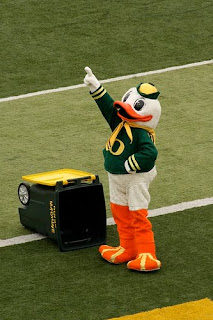
Teaching at Malone changed my career aspirations. I liked college teaching a lot and saw immediately that I would need a Ph. D., so I went off to Oregon to get one and became a Duck. Not much mystery about Oregon mascots. It's Oregon. It's wet. The major mascots are the Ducks and the Beavers. I learned today that the Duck mascot is called Puddles. It's cute, but that mascot does a pushup for every point the Ducks score and this year, we scored over 50 points a game. That doesn't mean 50 pushups. You do seven after the first touchdown and fourteen after the second touchdown and so on. It's a lot of pushups and the announcers who came to really like the Ducks this year, also came to like Puddles.

That leaves only Westminster College, where I taught for awhile after Oregon. Westminster was the Titans, which is a little awkward because there is no really good representation of what a titan is. The older titans were the rulers of the earth until Zeus and the other Olympians overthrew them. The younger titans are the offspring of Gaia and her son Uranus, so that isn't quite anything you want to do at halftime either. We didn't take it all that seriously at Westminster. We adopted the USC Trojan--complete with horse and Greek helmet--and said he was a Titan. Those who knew better didn't care all that much.

That's a lot of schools. And a lot of stories. Good for a cool rainy Saturday evening.

Saturday, June 5, 2010

New words are the fresh blood of a language. It's nice to have fresh blood. But it would be nice if it were healthy, rather than diseased blood. And it would be nice if it were not added at a rate that makes it difficult to assimilate it and get it circulating usefully. I also like new words, partly because I make them up myself, from time to time, and I need some kind of cover for doing that. And I realize that there are even better reasons than that for having them. I can "sync" my computer and my iPod in a way that has nothing at all to do with time. "Synchronize" still has that chron- in the middle, but "sync" doesn't need it any more. All is well.

However, I would not put a sticker on my car that said NEW WORDS ARE GOOD. For one thing, if you make new ones instead of using the old ones carefully, it gets harder and harder to say some things that really need to be said. I do have an example in mind, but for now, ask yourself why the expression "data points" had to be invented. Or why a sickly spinach plant would be said to be "healthy" on the grounds that it is good for you. Well. Enough of that.

I would like to write soon about pleasures; about "delights," more specifically, since delights are at the heart of being a dilettante. I would like to talk about significant and insignificant delights and I would like those words to refer to delights that signify--they act as signs of or that point toward--something and to delights that are attended to not because of their significance, but because they are there and they are delightful. That's what I'd like to do. I can't, of course, because "significant" is now most likely to be understood to mean "important." But I don't want to say "important" so I have to use a different word. I find that very trying.