Showing posts with label politics. Show all posts

Wednesday, July 27, 2011

Debt-Limit Chicken--And Worse

July 27, 2011. It is now less than a week until the United States of America tells the people who have loaned money to us that we were, after all, a bad risk. The debt limit confrontation has been pictured as a game of chicken between President Obama and Speaker John Boehner, the only presiding official in the Congress who opposes him. Sen. McConnell will have to wait his turn.

So…a game of chicken. We drive our cars toward each other at high speeds. In the best outcome, you flinch and turn aside and I win. In the second best outcome, I flinch and you win. In the least good outcome, neither of us turns and we kill each other. But now that I have gone that I realize that there is an outcome even worse. We both flinch and turn into each other (that would be to the right for you and to the left for me—how very familiar that sounds!) and reveals ourselves not only as cowards but as incompetent cowards. That would be worse.
I’m not sure that chicken captures all the elements of this contest, however, so I would like to try several others. How about Russian Roulette? You spin the cylinder, put the gun to your head, and pull the trigger. You have five chances out of six of surviving—if you do it one time. If you do it over and over—I’m not at all good at calculating cumulative probabilities—the odds get worse.

So let’s consider the roulette elements of the present situation. President Obama can’t control the Democratic votes he needs to pass the compromise he prefers. Speaker Boehner can’t control the Republican votes he needs to pass the compromise he prefers, which, until recently, was the same one the President preferred. The two parties are highly ideological. Votes which pitted 80% of Democrats voting one way against 80% of Republicans voting the other way were once unusual; now they are the commonest kind of vote. The new Tea Party-backed Republican House members believe they owe intransigence to their constituents—it is their sworn duty—and that intransigence has now been turned against the leader of their own party. This has led Eric Cantor, the Number 2 man in the House to tell them to “Grow up,” a sentiment also found on the lips of the President. How awkward is that?

This is highly unstable. Now we approach this brink over and over. The probability of hitting the live chamber, by this analogy, goes up radically as you do it over and over. Eventually, you will hit the live chamber—that would be the House in the present scenario—and you blow your brains out. Actually, that might have happened in the 2010 elections; it’s still too soon to tell.

The third scenario, one which captures yet another aspect of this impending disaster, is a champion battle. I’m thinking of David and Goliath as an example. I’m not really sure, now that I think of it, what was supposed to happen to the army of the defeated contestant. Were they supposed to be massacred? To be slaves? To be put in internment camps? I really don’t know. But it doesn’t really matter, because the notion of “champion” is all I need. Theoretically, if David wins, it is good news for the Israelites. If Goliath wins, it is good news for the Philistines. But fiscal default isn’t really like that. If we default, both David and Goliath lose. And all the people David and Goliath represent also lose. All of us are killed or enslaved or put in camps, or whatever. The cost to anyone of borrowing money for anything will go up, for instance. You don’t need to be on the losing side to suffer this defeat because both sides are the losing sides—not just the champions but the armies and not just the armies but the civilian populations. Everyone—litigators, bundlers of financial instruments and off-shore hiders of revenue and Chainsaw Al personnel departments—loses.


These three images together give us a fuller picture, I think, of what
we’re up against. This account sounds crude and contemporary to my ears,
however. This is how Lincoln put it.


“On the occasion corresponding to this four years ago all thoughts were
anxiously directed to an impending civil war. All dreaded it, all sought to
avert it. While the inaugural address was being delivered from this place,
devoted altogether to saving the Union without war, insurgent agents were in the city seeking to destroy it without war—seeking to dissolve the Union and
divide effects by negotiation. Both parties deprecated war, but one of them
would make war rather than let the nation survive, and the other would
accept war rather than let it perish, and the war came.”


Monday, July 4, 2011

SGO: Dog Poop

This leg of the Small Government Odyssey was suggested by an article in yesterday’s New York Times. Here’s the article, but the dilemma itself doesn’t require a lot of thought. Local dog owners are thoughtlessly leaving their dog’s excrement on your lawn or sidewalk.
I call it a dilemma because, in the context of the SGO—in which the game is to retain conflicts within the society or the economy and not let them bleed over into the polity—you must make a choice of solutions. The social sector solution would include things like caring about your neighbors or anticipating that if you do that to them, they will do it to you. From the standpoint of keeping the issue safely within the social sector, the one is as good as the other.
This might be the time to do away with the alternative that is superior to all others: character. If you lived in a neighborhood where people simply wouldn’t do that kind of thing to their neighbors, the issue would be resolved without any further fuss. Except that you have to ask where people of that character would come from. They come from families that teach good behavior toward the neighbors; and the families live where what they teach is generalized and amplified by the community. And, of course, the neighborhood takes steps to keep “outsiders” safely “out” because who knows whether the ethics of passersby match up with the ethics of locals.


The rules of SGO have, to this point, precluded an appeal to character so that the focus will be on keeping the conflicts at home, rather than allowing them to drift toward national government. Theoretically, there would be nothing wrong with passing an ordinance against allowing your dog to poop on your neighbor’s property and providing the necessary enforcement. I’m thinking of Poop Police (local police: I’m not thinking of adding another task to the Bureau of Alcohol, Tobacco, and Firearms) and maybe a culture of snitching, so that the police could be assured that the dogs who were not caught in the act would nevertheless be apprehended by vigilant neighbors.

That passes muster technically, because it doesn’t engage the national government. It does require local governments to use the law and its enforcement to prevent canine crime, however, and that really isn’t in the spirit of the Odyssey.

There is a way, though, to solve this problem without vigilant neighbors and without political interference. It is to export it to the economy. Here’s how it works.

Everyone who owns a dog in her complex, Timberwood Commons in Lebanon, N.H., must submit a sample of its DNA, taken by rubbing a cotton swab around inside the animal’s mouth. The swab is sent to BioPet Vet Lab, a Knoxville, Tenn., company that enters it into a worldwide database. If Ms. Violette finds an unscooped pile, she can take a sample, mail it to Knoxville and use a DNA match to identify the offending owner
.
Called PooPrints, the system costs $29.99 for the swabbing kit, $10 for a vial to hold the samples and $50 to analyze them, which usually takes a week or two. The company says that about two dozen apartment complexes around the country have signed up for the service.


Now, no one has to live at Timberwood Commons. But it you do and if you have a pet, you do have to have the pet’s DNA registered. Ms. Violette finds the offending pile, sends the sample in, determines the culprit, and fines the culprit’s owner. Unless the culprit’s owner sues (juridifying the issue, if you recall Frank Heard’s categories from the first SGO post), there is no governmental involvement at all. There are no neighborhood vigilantes because there is no need to catch the offending pet in the act. Well after the act is still plenty of time for PooPrints.

The angry neighbors are transmuted into knowledgeable onlookers. They need only wait for justice to be done. The “bad neighborliness” is turned into an economic opportunity for the BioPet Vet Lab. The offending pet’s owner knows he has only himself to blame and in order to avoid future penalties will comply with the rule. The hope of getting away unidentified is now a forlorn hope.

Again, good character is a better solution in every way except adding to the Gross Domestic Product (such an apt name in this instance). Good character would have the residents at Timberwood Commons take care of their animal’s scat because it is the right thing to do. It is but one instance of a robust regard for the good opinion of the neighbors and a willingness to be a community-affirming member rather than a limits-testing member. But failing “good character,” there is PooPrints.

Tuesday, June 28, 2011

What Will Happen in Afghanistan?

This is going to sound cynical. Maybe it actually is; I’ve gradually been losing my ability to tell. But this post really isn’t about Afghanistan. It’s about us and how we talk ourselves into doing what must be done.

Imagine that a father is dropping his son off at the bus station. The son is off on his first bus trip. He looks uneasy. The father is loth to leave him at the station by himself when he seems so uncomfortable. On the other hand, the father has a meeting and really needs to leave. Father and son come to an understanding—ordinarily, this is done without words—that the son will stop looking uncomfortable. This will permit the father to leave for his meeting, even though he knows his son is uncomfortable. The son, as a practical matter, grants his father permission to leave by appearing confident until after the father has left.

There is a lesson here. Whatever must be, will be.


We need to leave Afghanistan. That’s what must be. We don’t want to leave a failed state behind us. We don’t want to have failed in our mission, whatever it was. So we will be hearing the stories that will enable us to leave. Here are six of those stories.


First, the Afghan government is pervasively corrupt. I’m inclined to believe that is true, but my point here is that we need to hear that story whether it is true or not. “Corrupt” means that no additional money or handholding or training of local forces will be “enough.” That means that “staying until the job is done” is no longer one of the options and also that “leaving before the job is done” is not our fault.


Second, we will hear that the warlords are not as bad as we thought. These warlords will become “provincial leaders” fairly quickly, because we don’t want to abandon Afghanistan to warlords. The provincial leaders provide stability, after all. They control the countryside. They are the de facto governments in most of Afghanistan and will be the de jure governments as the grasp of the central government loosens further. Since we don’t want to pull out and leave the Afghan people in the hands of ruthless and irresponsible warlords, we will pull out and leave the people in the safe keeping of “local leadership” instead.


Third, we will hear that the true goal in Afghanistan is to prevent al Qaeda from having “a safe haven” to plot their evil deeds. That means that the Taliban are really not our reason for being there. We will hear that most of the Taliban troops are really just mercenaries. They would become “government troops” or “provincial troops” if someone paid them enough. They aren’t bad guys, really; just for rent to the highest bidder. The Taliban leadership, on the other hand, need to be included in any stable arrangement because they are…well…Afghans and we are not. So the leaders will be invited to “peace talks” where there will be “frank exchanges of opinion,” and the followers will be hired by the government to protect Afghanistan from themselves.


Fourth, we will hear that the war against al Qaeda is going nicely. What with the targeted assassinations of a substantial part of their leadership and a flurry of targeted drone strikes in Afghanistan and Pakistan, al Qaeda’s ability to plan and carry out attacks on Americans at home and abroad has been limited. So the “war aims” have been achieved and we can leave Afghanistan as victors.


Fifth, we will hear that it is costing a lot to sustain our present effort in Afghanistan. That’s always been true, of course. But now, we will hear a lot more about it because it is the “pull.” The acceptability of the conditions we are leaving in Afghanistan—achieving the war aims and all—are the push. The unsustainable cost of continued war there is the “pull.” President Obama has begun to talk about “nation-building” here at home (which is not seen as something we can and should do) rather than “nation-building” in Afghanistan which is something we can’t do and so, as a practical matter, something we have already completed successfully.


Sixth, we will hear that Pakistan is, in any case, a more crucial ally than Afghanistan, and that our continued hostilities in Afghanistan have put the government of Pakistan in a very tight place. Pakistan has al Qaeda enemies too and what we have done exacerbates Pakistan’s ability to act in its own best interest. So pulling out of Afghanistan is not a step away from Afghanistan so much as a step toward Pakistan, which is a more important ally in the long run and which, in any case, has nuclear weapons.


All these stories will add up to the boy at the bus station being no longer afraid. Since he is no longer afraid, the father can go off to his meeting having fulfilled the duties of fatherhood. The duty of fatherhood in this case is not, whatever we might like to think, refusing to leave a frightened boy at the bus station—the father actually is doing that. No, the relevant duty is getting the boy to understand that he needs to stop looking frightened so the father can get on with his work.


What must be, will be. We will hear the stories that will tell us that it is a really good idea to do the things that we would have to do whether it was a good idea or not.

Thursday, June 9, 2011

Small Government Odyssey (SGO) Creationism

This post continues my Small Government Odyssey (SGO), a series of reflections on what it would take to reduce the size of government on the one hand, while seeing to it that the legitimate needs of the citizens are met (by someone, but not by the national government) on the other.


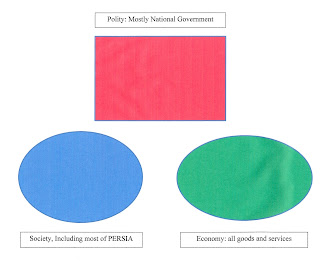
The diagram shows economic, social, and political sectors. My argument is that to the extent that the needs of the citizens are met in the social sector (families, schools, neighborhoods, clubs, etc.) and in the economic sector (producers make money, consumers receive affordable goods and services, employees receive a living wage), there will no appeal to the political sector. The size of government, accordingly, will shrink. So will the proportion of the GNP it consumes and the power it gets from making authoritative decisions on the appeals made to it by dissidents in the economic and social sectors.


This view does not distinguish between legitimate dissidents and illegitimate ones. In the small government business, the focus is on reducing the appeals to the national government made by people who think they aren't being treated fairly in the social and economic sectors. It is what they think, not what a panel of fair-minded citizens decide, that makes them want to invite government in--an action we all pay for in higher taxes and fewer freedoms. You can do that by simple repression, of course, but repression gets expensive after a while, so that is self-defeating. You can do it by lowering expectations, but the principal commercial strategy involves raising expectations, so that isn't a sure thing either. You can do it by coopting resentment or by deflecting it to other targets, but whenver that fails, the federal government is there, looking for an invitation to substitute their judgment for yours.


In fact, school boards are governments, so they are part of the polity. The force of these questions, however, has to do with the national government, so for the purpose of this question, I am going to consider the school boards as part of society, rather than polity. If we want the national government to stop interfering with the preferences of local boards and the parents who elect them to office, what would we have to do?Since the Constitution forbids any promiscuous mixing of religion and government, we would have to find that Creationism is not a “religious doctrine.” It is a theory, like any other, about the origins of our world and the species of plants and animals that have come to live on it. Evolution is a theory and Creationism is a theory and which theory is to be taught is to be at the discretion of the local voters. That would work. The national government does not intervene in local school district decisions to mandate balanced histories or any particular approach to art or any of several methods of teaching arithmetic.


Under this scenario, biology would work the same way.Once the political hysterics had quieted down, however, the professional side of the question would have a chance to emerge. Just as there are pharmacists who refuse, on personal grounds, to dispense drugs they disapprove of, so we might find some biologists who refuse, on professional grounds, to teach poorly supported theories in place of well-supported ones. Just as the voters who elected the judge must share their authority with the judge’s professional promises, so the school district voters would have to share their authority with the teacher’s professional promises. It wouldn’t be an altogether bad idea if science teachers adopted “First, Do No Harm” as their professional motto.


If there were a professional certification by the Biology Teachers of America (so far as I know, a fictitious organization) and if you couldn’t teach biology without a professional certificate, then schools would have to choose between certificated biologists—who would emphasize the value of well-supported over poorly supported theories—and noncertificated biologists, who would teach anything the school board demanded of them. Parents might gather in silent protest at the home of a certificated science teacher who refused to teach Creationism in his biology class, but the teacher has his oath to protect him and the parents would have to choose between a well-prepared teacher for their children and an ill-prepared one.


Presumably, colleges and universities would not be forced to treat applications equally—those from school districts with professionally certificated teachers and those from districts without them. It would take action by the national government to require them to accept students who were, in the judgment of the university, ill-prepared for university work. We are trying to do without national government intervention and besides, there is the question of the grounds on which the government might intervene.


The Constitution requires the intervention of the national government in the affairs of the school districts IF Creationism is a religious doctrine.[1] If it is not a religious doctrine, then the present appeal to national government authority falls short and local preferences prevail. This provides a wonderful opportunity for biology professionals to decide what they are willing to do, as educators, and what they will need to refuse to do because of the harm it would cause.


For myself, I would rather see a conflict between a popularly elected school board, on the one hand, and professionally accountable biologists on the other than a conflict between a national government wielding the Constitution and local school boards wielding parent preference. I think it would be a more useful conflict and I am quite sure it would be more fun.


[1] It wouldn’t have to be religious. There are agnostic versions. “The earth and all subsequent living things were created at a single recent time, but the data now at hand provide us no way to say how that happened.” There are thousands of theistic versions. Nearly every culture, no matter how small or how isolated, has an account of how the god [name of local deity] or the gods [name of college of local deities] created the world and all that is therein. There could be a rotation of Creation myths, using each in turn.

Monday, June 6, 2011

D-Day and Global Warming

Questions don’t aggregate the way purchases do. When you have a million purchases, they push up “consumer demand.” When you have a million questions, they might not aggregate to anything at all.

Democracies are better in crisis conditions. The Framers devised a government that wouldn’t work very well under most circumstances, but when a crisis loomed, cooperation would span the chasms that normally separated the branches from each other and the states from the federal government and “considerate and virtuous citizens” from the uneducated rabble. Madison’s republic is built on social distrust and Newtonian mechanics. In a crisis, we get to keep the mechanics, but the common threat does temporary duty as “trust” and we work together. That’s the idea.

You’d think we could do it better than that after a while. Still, every looming (as opposed to an actually occurring) crisis takes power from some and gives it to others. That means that the industry of pointing to and describing the steady advance of a “looming crisis” is a rapidly growing industry. Taking one step in any direction is hazardous if there is a slippery slope two steps in every direction. And if experts, now widely reviled as the tools of [fill in name of group] can’t be trusted—and they can’t if there is always a group of “my experts” opposed by a group of “your experts”—then every uneducated opinion is as good as any other.

Under those circumstances, questions don’t aggregate. Therefore answers don’t aggregate. Therefore planning for crises that are certain but not immediate, is stuck in the governmental dilemma the Framers built for us.

I have global warming in mind. The idea of the canary in the coalmine is a warning sign from the standpoint of the miners. When the canary dies, we miners feel an urgent need to get out and get some fresh air. But with global warming, everyone feels that someone else is “the miners.” We are prepared to mourn the loss of that innocent canary, but we still believe in coal and we aren’t the ones in the mine. But, of course, we are.

It is a difficulty, particularly in the case of global warming where we actually ARE the miners, but it is not a new difficulty. Here are a couple of clips from Herman Wouk’s The Winds of War. It’s a fictional account, but Wouk continually faces the dilemma of making up “new facts” when the actual ones are widely known, or just using the correct ones. In those circumstances, he simply fills in the true history as the context for his characters, some of which are fictional (Pug Henry) and some of which are not (FDR).

On Memorial Day, 1940, the actual President Roosevelt asks the fictional Pug Henry to join him in the President’s reviewing stand. During the parade, Roosevelt handed Henry a slip of paper with these numbers on it.


Public Attitude Toward War, 28 May 1941
For getting in if no other way to win 75%
Think we’ll eventually get in 80%
Against our getting in now 82%


Here’s a little speech Roosevelt gave to Pug Henry along with the slip of paper. So far as I know, the speech is fictional, but the concerns were thought to be strategically plausible.
“If we get into war, Hitler will at once walk into French West Africa. He’ll have the Luftwaffe at Dakar, where they can jump over to Brazil. He’ll put new submarine pens there, too. The Azores will be in his palm. The people who are screaming for convoy now (“screaming their opposition to U. S. convoys,” he means) simply ignore these things. Also the brute fact that 82%...of our people don’t want to go to war.”


This is May 1940. In August 1940 the Congress passed the Selective Training and Service Act of 1940, just in case the United States might need an army if it were to enter the war. The bill passed the House of Representatives by a single vote, and even that might have benefited from the very agile gavel of Speaker Sam Rayburn. In December, Japan attacked Pearl Harbor and we declared ourselves in a state of war against “the axis powers.” Roosevelt in his little speech was looking at the seemingly unstoppable German army on the one hand and the implacable opposition to war by four fifths of Americans on the other.


In this instance, Japan provided us the canary in the coal mine. That is what got us from that 82% to D-Day in France, 67 years ago today. The attack on Pearl Harbor wasn’t just a catastrophe; it was an act of war. It was the infliction of harm by a navy willing and able to inflict it. Being attacked, like the prospect of being hanged, “concentrates the mind wonderfully. I chose a landing craft view for D-Day, by the way, because a friend of mine at church piloted one of those on D-Day. It's not the most graphic picture of the invasion I have ever seen, but it is the one he saw, so it matters to me.

Global warming isn’t like that. No one attacks. Polar bears drown. The mythical “Northwest Passage” becomes actual. Investors are buying up land on which wheat has never been grown so they will own it when the temperatures and the rainfall at those new latitudes will support wheat farming. The water at Florida’s coastlines is rising, by my best recollection, at the rate of an inch a decade. Here is a collection of more scary stuff.

But the questions about global warming and what to do about it don’t aggregate into a single national concern. No one has attacked us. The canary hasn’t died. And most of the people think there will be plenty of time to “do something” when the crisis in upon us. Then they will demand that Congress pass HR 1, the “End Global Warming Now” Act. Then they will complain about the untrustworthiness of government when the climate doesn’t turn around, as Congressional mandate has instructed it to, and return to the values of 1700 A. D.

If it was a real crisis, someone would have warned us, right?


Friday, May 27, 2011

Do the Democrats Want to Govern, or Just to Win?

So now Democrat Kathy Hochul beat Republican Jane Corwin late Tuesday in the special election for New York's 26th congressional district. Rep.-to-be Hochul gave the three reasons for her victory as, and I quote, “Medicare, Medicare, Medicare.” The two questions I want to poke at, using her explanation as a platform, are: 1) what does she mean by that answer and 2) what does that imply for the organization of the 2012 election?

Jane Corwin did not back away from Paul Ryan’s budget plan fast enough if, indeed, she backed away at all and Kathy Hochul beat her senseless with it. There are a lot of good reasons for people, seniors especially, to be wary of Ryan’s plan, but there are a lot of silly reasons, too, and I’d really like to know how those two moods played out in the New York 26th Congressional District. If Hochul means that Corwin offered too deep a cut in Medicare or flawed set of targets for the reduction, all is well. A less draconian cut or a fairer sharing of the fiscal pain will be the next topic of conversation.

On the other hand, if Hochul’s victory is only the prelude to a season of incessant demonization of anyone who is trying to rein in our exploding medical expenses, then the prospects for anything I would call “government” are bleak indeed.

Let me take a brief etymological excursion to justify that last statement. We get the English “government” from the Greek kubernatos, meaning “helmsman” or “pilot.” The helmsman—that’s the government—is supposed to steer the “ship of state.” I think that’s an excellent idea. It makes it possible for the polity to decide upon a corrective action, put in place a helmsman who will implement that action, and as a result, we avoid piling up on the rocks. There is another approach, though, which holds that having a helmsman of any sort is a bad idea. This wasn’t really Reagan’s idea but, as in so many areas, he formulated a way of characterizing it that has stayed with us. “Gummint,” said the President, “is not the solution to our problems. Gummint IS the problem.”

We are perilously close to a shipboard management scheme that could be characterized as a biennial mutiny. And I choose “biennial,” knowing that the President’s term is four years. Someone is chosen as “head of staff,” let’s say, and this sets off boisterous opposition. This opposition is successful either in lashing the helmsman to the mast—well out of reach of the helm—or in substituting another helmsman for the current one. Since the substitution sets off a boisterous rebellion among the partisans of the former helmsman, a new mutiny begins immediately. In the meantime, it is worth asking who is steering the ship of state, when no one can keep the helm long enough to maintain a course. End of excursion.

In the light of the Hochul victory, the Democratic Party needs to decide immediately whether it wants to win or to govern. The ugly fact is that demonization of your opponents works if winning elections is all you care about. The Republican Party hit a new low in the last round by their opposition to “Death Panels.” It was low, but it was successful. The Democrats could retaliate, if they wanted to, by saying that the Republicans are trying to “destroy Medicare as we know it” to adapt one of President Clinton’s best-known phrases.[1] This would probably work. Droves of Rs would lose; droves of Ds would win. Then they would be faced with trying to do something about Medicare costs, knowing that whatever they tried, the Rs would give them what they had just received, seven times hotter. When it comes to virulent invective, it truly IS more blessed to give than to receive.

On the other hand, if the Democrats really want to govern, they will not demonize the Republicans. They will use Rep. Ryan’s overshooting the mark as a way to move quite a way toward cutting Medicare expenses. The fact is that “Medicare as we know it” is bankrupting us. Everyone knows that. We are going to have to find a way to cut back on what it costs. Everyone knows that. But the Democrats can afford to take a substantial risk in drafting behind Ryan if they really want to govern.

“Our plan,” they can say, “is much more reasonable than Rep. Ryan’s plan, which has been endorsed by the Republican leadership. Our plan goes a long way toward solving the Medicare crisis, but it does so in a responsible way and without dumping the government’s responsibility to care for seniors.” [2] By positioning themselves to the left—but not too much to the left—of the Republican plan, the Democrats can get a lot of spending reduction accomplished AND retain office. They will lose more seats by what I am calling “the governing plan” than they would by following “the politics plan,” but there would be compensations.

The first compensation is that they can claim to be taking the fiscal crisis seriously. They claim that now, but no one believes them. To be believed, you have to establish your credentials in conflict. If 2012 turns on The D Plan v. The R Plan and the Ds win, they will have their credentials and enough votes to implement a substantial part of the plan.

The second compensation is that eventually, there will be political gold in being able to stand before the public and be recognized as “the party that made the hard choices and that rescued Medicare.” Eventually. Maybe not in 2012, but possibly before 2016, when they will really need it.

It’s worth a try.

[1] It is worth noting, however, that when President Bartlet was offered that same phrase, it set off a major conflict among the West Wing staff, the result of which was that Toby Zeigler talked the President out of using it at all. And Toby did that with the full support of Josh Lyman, who had been his principal opposition on this question and who ended the scuffle by saying, “I make it a practice never to disagree with Toby when he’s right, Mr. President.” Fiction is SO much more satisfying than reality.
[2] President Obama’s plan to cut the cost of Medicare by refusing to pay for procedures that the experts can demonstrate to have no beneficial effect, is not going to do it. It isn’t public enough, for one thing. And it looks suspiciously like “government by experts,” which, in this era of populist anger, isn’t going to do it either.

Wednesday, May 18, 2011

Nuclear Crisis in Japan--and Here

What shall we learn from the failure of the Fukushima Daiichi nuclear power station in Japan? Until the power of nature made itself felt, things were pretty well controlled by powerful people. As I read this account in the New York Times for May 16, it struck me that earthquakes are hard to predict, but the dominance of the powerful…that’s not so hard to predict.

Hindsight is notoriously unforgiving, certainly, but I don’t have in mind blaming the people who made these costly decisions or even praising the people who warned of the dangers. What strikes me in this account is the banal predictability of it all.

In the U. S., the oil crisis of the early 1970s causes long lines at gas stations and short tempers nearly everywhere. In Japan, it was much more dire. As a result, in 1976, Japan committed to nuclear power as the power of the future. Nuclear power looked pretty good compared to oil, but, as Katsuhiko Ishibashi, a seismologist and now professor emeritus at Kobe University, said, “The Japanese archipelago is a place where you shouldn’t build nuclear plants,” Oil in unattractive as a fuel because Japan doesn’t have any. Nuclear is unattractive as a fuel because Japan is an earthquake zone. It’s a dilemma.

There was an earthquake near Kobe in 1995 and residents, fearing for their safety, began organizing protests again the operators, Chubu Electric. It’s not easy to protest a strategy that seems to have no alternative. Yasue Ashihara, a protester at another plant, said she believed the company is understating the danger to her city, but that “she has at times felt ostracized from this tightly bound community, with relatives frowning upon her drawing attention to herself.”

In 2007, a district court ruled against the plaintiffs, finding no problems with the safety assessments and measures at Hamaoka. The court appeared to rely greatly on the testimony of Haruki Madarame, a University of Tokyo professor and promoter of nuclear energy, who said it was unlikely that two generators would fail at the same time and, more ominously, that the concerns of the plaintiffs would “make it impossible ever to build anything.”

The protesters were successful in only two cases, both of which were overturned by a higher court. In one of the two cases, residents near the Shika nuclear plant in Ishikawa sued to shut down a new reactor there in 1999. They argued that the reactor, built near a fault line, had been designed according to outdated quake-resistance standards. The court sided with the power company, arguing that the plant had been built according to the new safety standards, adopted in 2006.

And they did meet those standards. The standards had been set by a government panel composed of many experts with ties to nuclear operators. The standards essentially left it to the operators to make sure their plants met the new standards.

It isn’t all that easy for judges either, says Kenichi Ido, the chief judge at the district court at the time. “I think it can’t be denied that a psychology favoring the safer path comes into play,” Mr. Ido said. This would be the “safer path” for the judges, please note: “Judges are less likely to invite criticism by siding and erring with the government than by sympathizing and erring with a small group of experts.”

There is a good deal of incentive for the companies to underestimate or, sometimes, simply to deny the existence of the kinds of risks fault lines represent. In the case of Kashiwazaki-Kariwa nuclear plant in Niigata, Tokyo Electric Power Company, or Tepco, the utility that also operates Fukushima Daiichi, did not disclose the existence of an active fault line until an earthquake forced it to. In 1979, residents sued the government to try overturn its decision granting Tepco a license to build a plant there. The Tokyo High Court ruled against the plaintiffs, concluding that no such fault line existed.

“This is ridiculous,” said Hiroaki Koide, an assistant professor at the Research Reactor Institute at Kyoto University. “If anything, Fukushima shows us how unforeseen disasters keep happening. There are still too many things about earthquakes that we don’t understand.”
Until March 11, Mr. Koide had been relegated to the fringes as someone whose ideas were considered just too out of step with the mainstream. Today, he has become an accepted voice of conscience in a nation re-examining its nuclear program.

Yasue Ashihara and Hiroaki Koide are shunned as showboats or as being “out of step with the mainstream.” They bring actions in court, but the operators defend themselves by underestimating and then denying and then, finally, admitting the risks. The admitting part most often occurs after the disaster has occurred. The judges take “the path of safety” by agreeing with the operators and the government, rather than the residents.

When new estimates of the power of the fault lines are presented, new estimates of the robust construction of the power plants are presented. The standards are devised presuming the good faith of the operators, but the operator’s interest in their own success inclines them to cut corners and run risks.

Then a disaster occurs and the protesters are shown to have been right; the operators are shown to have been wrong. Now what? Japan still doesn’t have any oil. The archipelago is still a bad place to build nuclear plants. The government planners still make plans so that it will not be “impossible to build anything ever.” The operators still overestimate the stability of plant construction and underestimate the extent and power of the faults.

Which of these conditions is going to change in Japan? Do we really think any of them are different in the U. S.? Which ones? Will the residents be less vigilant? The government less permissive? The operators more forthcoming? The judges more daring?

I don’t think so.


.

Monday, May 2, 2011

The Death of Osama bin Laden

I’m having trouble knowing how to feel about our finally having killed Osama bin Laden. I’m having trouble knowing how to think about it too, which is more immediately troubling, because I usually know what I think before I know how I feel.

I’ve been thinking about this day since President Bush first began to characterize the American response. Here’s a clip from CNN.U.S.

Osama bin Laden is the "prime suspect" in last Tuesday's terrorist attacks in New York and Washington and the United States wants to capture him "dead or alive," President Bush said Monday.

Speaking with reporters after a Pentagon briefing on plans to call up reserve troops, Bush offered some of his most blunt language to date when he was asked if he wanted bin Laden dead.


I want justice," Bush said. "And there's an old poster out West I recall, that said, 'Wanted, Dead or Alive.'"

So that’s where I start. A cowboy president talking about a wanted criminal, equating his capture or his death, and calling either “justice.” That’s what President Obama called it too, in his speech last night: “justice.”

Maybe this is the place for me to say that I missed 9/11. I was at the hospital helping to prep my wife for the first of several cancer surgeries. I saw the report on the hospital TV monitors, but I didn’t care very much at the time. I had more pressing matters. As a result, I don’t feel the sense of closing of the circle of this event the way I might have otherwise.

Certainly, I don’t feel bad about bin Laden’s death. He declared war on the United States and we have been killing his followers as fast as we could find them ever since. Our assassination of bin Laden is part of the same war as his attack on the World Trade Center. Wars produce casualties.
On the other hand, successfully prosecuting a war against your enemies is not ordinarily called “justice.” Why is it not “revenge?” Certainly that is the way bin Laden thought of the 9/11 attacks; he was avenging some group—you can almost take your pick—for the acts of war against it/them by the United States.

The good thing about “justice” as an explanatory term is that it suggests a natural ending. A criminal commits a horrific act; he is apprehended, charged, convicted, and sentenced; then “justice is carried out,” whatever that means in practical terms. And then it’s over. The sheriff comes to town, challenges the bad guys, kills the bad guys, and rides off into the sunset to the accompaniment of applause from grateful townspeople. Justice was done, we say.

The bad thing about revenge is that there is no way to punctuate it. With what act does it start? Does it end while there are still potential combatants available? Is it over when the sense of honor that requires it has finally waned to levels that don’t show on the meter anymore? It is over when “what honor requires” has moved beyond tit for tat?

All of our stories begin with 9/11. Everything was fine before that and then a bad person did this awful thing and now we have done an awful thing back and now it’s over. Does that sound at all plausible? I offer the following comparison, not to equate the gravity of the two offenses, but only to point to the difficulties of punctuating events “correctly.” Everything was fine and then Pastor Terry Jones desecrated the Koran, so we retaliated by killing some people from his “group”—that would be the infidel West, I guess—and now it’s over. Does that sound at all plausible?

I appreciate President Obama’s sober approach to this event in his speech. I admire the speech itself. Having written a fair number of speeches, I admire the craftsmanship. Had I written the speech, I am sure I would have advised him to use the word “justice” just as he did.

But the fact is, “justice” is a term in a certain kind of story and this is not that kind of story.


Sunday, April 3, 2011

Being Against "Injustice"

[Please accept my apologies for the crude spacing. My blog is not currently accepting the spaces I ordinarily put between paragraphs. Thank you blogspot.com. The asterisks are the least intrusive spacing device I have thought of (and Bette thought of that one). If anyone has a better idea, I hope you will let me know. Or, even better, let blogspot know.] The American view of justice sounds familiar to me. In fact, it sounds just like us. It reminds me of Justice Potter Stewart's "definition" of obscenity, which was "I know it when I see it." ************************************************************************************************************************************************************ Americans don't have a clear view of what "justice" is and as a result, our discussions among ourselves never end and never decide. We have a much clearer view of what "injustice" is. This is the difference, if I may just play with the words a little here, between Justice Stewart's lack of interest in defining "scenity" and his interest in defining "ob-scenity" clearly enough that it could actually be achieved. ************************************************************************************************************************************************************ When we saw bad things happening to unresisting Negro protesters--if you are in my 101 class, the chances are that you will not remember "Negro protesters”—they seemed so harmless and so ill-used and we saw it all on television. That is what made the civil rights movement popular among northern liberals and tolerable even among northern conservatives. All these pictures of "injustice" shoved in our faces. Surely we can't be asked to just stand by. ************************************************************************************************************************************************************ Now we are seeing pictures of Khadafi (or Gaddafi) threatening the overwhelmed people of Benghazi, Libya and we think we surely can't be asked just to stand by. So we haven't. We have attacked Libyan air defense installations, then planes, then tanks, then concentrations of the Libyan army. Now CIA agents are on the ground for the purpose of "targeting" future airstrikes. ************************************************************************************************************************************************************ Some positive notion of "justice," some sense of how it really could be for a society with Libya's current make up and recent history, would really help us. Do they need to be a national, rather than a tribal, society? If they insist on being Muslim, could they be secular Muslims? Do they need the civil institutions that will allow they to transcend the narrow loyalties that have sustained them to this point in their history? Whether they need those or not, those will not be--trust me, they will NOT be--the first projects they take on. Will we take them on, on their behalf? ************************************************************************************************************************************************************ Will we be the teachers of "ultratribalism?" Will we formulate their civil institutions: impartial, impersonal, and fair? Will we offer our kind of religion, a distant, pale, buffet line kind of religion, in exchange for theirs? Are we, in other words, prepared to work toward some peculiarly Libyan incarnation of "justice?" Or do we just want to condemn and oppose "injustice?" We do, after all, have several other acknowledged wars going on and we have to judge our appetite for substantial investment in a society where our failure may safely be taken for granted.

Wednesday, March 23, 2011

Just How Bad is Colonel Kadafi?

I was living in Missoula, Montana in the summer of 2002. The U. S. was ratcheting up the war of words against Iraq. The American military was preparing for war there (note the active verb) and the American public was being prepared (note the passive verb) for war there. The First Presbyterian Church of Missoula held a series of midweek lectures that summer (lectures with discussion, it turned out) and one of the lectures had to do with this increasing bellicosity toward Iraq. The church membership was mostly conservative but some of its members were faculty at the University of Montana and they were mostly liberal.

I was there for the lecture on Iraq. It was given by a faculty member whose name I have forgotten, but I will never forget his pitch to the congregation. He was warning against the impending invasion of Iraq in the strongest terms. He was warning a gathering of his friends, nearly all of whom thought that removing Saddam Hussein, that “Hitler of the Middle East,” was our duty. The speaker made a good case against the war, but it was a pretty standard case. I could have made it, myself. But he got a hearing for his point, which I would not have been able to do, by talking about all the nights he and a lot of his fellow members stayed after meetings to finish washing up the dishes. He apologized to another section of the congregation whom he addressed as “my fishing buddies,” for the contentious nature of the argument he was making. He was wonderful. I understood why he was so well received in a church that had no ears at all for his message.

Afterwards, I had a conversation with an old man with a very heavy German accent. I am going to try to represent the accent in the way I spell his words because I want you to be able to “hear” what I heard. The old man said, “I know vere ziss iss goink. I haff heard all ziss before.”

My blood ran cold. I knew he had heard it from Hermann Goering in the 1930s. He heard it over loudspeakers, and all the radio stations, and saw it on the “newsreels” in the theaters. This is the Goering who said:

“Naturally the common people don't want war; neither in Russia, nor in England, nor in America, nor in Germany. That is understood. But after all, it is the leaders of the country who determine policy, and it is always a simple matter to drag the people along, whether it is a democracy, or a fascist dictatorship, or a parliament, or a communist dictatorship. Voice or no voice, the people can always be brought to the bidding of the leaders. That is easy. All you have to do is to tell them they are being attacked, and denounce the pacifists for lack of patriotism and exposing the country to danger. It works the same in any country.”

This week, I have been feeling a little bit like that old German man. Muammar el-Qaddafi is getting more reprehensible by the day, following the path by which Sadaam Hussein got more deplorable by the day. For people who pay any attention at all to public affairs and who are old enough to remember the run-up to the Iraq War, this has got to sound familiar. We may be excused for feeling, “I haff heard all ziss before.”

So just how bad is Kadafi? We can’t know, of course, so I have another way of approaching the question. How bad do we need him to be? I think someone who knows more of the facts on the ground in Libya and on the proper floor of the Pentagon could work out a correspondence that would help us. I’m thinking of something like this.

1a. Kadafi is a pompous hypocrite.
1b. We are trying to draw that attention of potential allies to the need for some action against Libya.

2a. Kadafi is terrorist.
2b. We have begun efforts to isolate him diplomatically and economically

3a. Kadafi has unleashed the power of a brutal regime against his own people.
3b. We have decided to neutralize his air defenses and to ground or destroy his air force.

4a. Kadafi is a clear and present danger to everyone and has a stock of mustard gas that he will unleash on anyone he deems an enemy.
4b. We are about to begin bombing civilian targets in Tripoli and are making “surgical strikes” against buildings where Kadafi or his family might be hiding.

We could go on, of course. I am not saying that any particular charge about Kadafi is untrue. I don’t really know. My point is that if they are true, they were always true—he took over in 1969, when my 50 year-old daughter was not yet 10—and the information we can glean from which ones are trotted out is best treated as the information that will justify whatever we are preparing to do next.

I know that’s cynical and it may not be fair, but I haff heard all ziss before and I am deeply uncomfortable.

Footnotes:
1. I haven’t made a study of this, but my guess is that the spelling of his name is going to get stranger and more foreign-looking by the day. Imagine a time when we referred to him as “Uncle Mo-Mo” in the way we were taught to refer to “Uncle Joe” Stalin after the U.S.S.R. became our ally in World War II. He could then become “Colonel Kadafi,” which isn’t that bad since there are U. S. colonels as well. And maybe after a few references to that title, it might just be “the Colonel,” to call up the notion of Kentucky Fried Chicken. Then we could go to the whole name, Moamar Kadafi—the pronunciations would vary, I am sure from NPR to Fox News—and get, eventually, to the form I saw in the New York Times today, Moamar el-Qadaffi. Notice the –el (strange and foreign-sounding) and the substitution of Q for K as the first consonant. Short of “Adolf el-Qadafi,” I don’t know where else there is for us to go.

2 Should it become necessary, we can always begin referring to Libya by its official name, “Great Socialist People’s Libyan Arab Jamahiriya.”

Monday, February 21, 2011

What is a mandate?

In the most often used setting, it is really hard to tell. Every party with a majority in one house of the legislature says it has a “mandate” to do what at least some of the candidates promised to do in their most recent campaigns. President Obama claimed he has a mandate to deal with the nation’s healthcare woes as a result of his victory in 2008.

That isn’t the clearest meaning of the term, certainly. The handily available Latin source is the verb mando, “to command.” The Congress, for instance, “commands the Environmental Protection Agency to start obeying the law and the EPA fights back, saying the Congress does not have the right to mandate such an action.[1] The Congress demands that certain states where minority voting has been suspiciously low actually register minority citizens and allow them to vote. The demand was specific and was backed up by the kind of penalties that catch the imagination. Those are mandates.

What do the voters “demand?” That’s harder. The EPA decision was 5-4. You could say that five justices demanded that the law be obeyed and four demanded that it not be obeyed. Both are mandates; one carries the prestige and power of the Court and the other does not.

Command, connotes, at the very least, that only one thing is being demanded, but in popular votes, contrary things are being demanded. The voters are apparently not of one mind.
But if they were of one mind, what would they be saying? One of the simplest divisions of the popular vote is among those who vote for a candidate, those who vote for a party, and those who vote for the candidate closest to the voter’s stand on some issue. Imagine, in that case, a unanimous vote for Barak Obama in 2008. That would be 69, 484,215 votes for Obama. Now imagine that 23 million voted for him because he was black (a candidate-oriented vote); 23 million voted for him because he was a Democrat (a party-oriented vote); and 23 million voted for him because he promised to end the war in Iraq promptly. What is his mandate? Keep on being black? Continue being a Democrat?

In fact, I think things are more confusing than that. Many voters have a sense that there ought to be a balance in public policies and they feel, sometimes, that “things have gone too far.” I don’t want to have to be the one to say that things could not go too far, but it seems to me that “too far” requires a single policy axis. Most often, the political arguments are not made on a single policy axis. Take the current wariness about the necessary budget reductions, for instance. If the policy axis is “live within our means,” then people are overwhelmingly in favor of it. If the policy axis is “do without crucially important government services,” then people are overwhelmingly opposed to it. If the policy in question does both, how shall we determine a “mandate?”

I think this sense of “too far” is a little like the thermostat. We get to “too cold” and the thermostat kicks the furnace on. We get to “too warm” and it kicks the furnace off—or, in some homes, kicks the furnace off and the AC on. The thermostat works on what I call a single policy axis. It doesn’t have a setting for “using too much of the world’s resources.” It doesn’t have a setting that says, “Conservation is the same as a reduction in the demand for energy; get a sweater.” It’s just on and off.

But I think it’s worse than that. The thermostat doesn’t have a minority vote, so that it can kick the furnace on by 5-4 but the minority is large enough to keep the AC on as well. The thermostat doesn’t take reaching the “send a message to the furnace” temperature, decide enough is enough, and send a crew down to rip out the furnace. The public, operating as it does on multiple policy axes, doesn’t so much turn on and off the furnace, as send a crew down to tear out the furnace; then another crew to install a furnace, when it gets cold.

Of course, that would be more expensive, but the Framers didn’t give us democracy because it was efficient. They gave us a democracy because they had just fought a war against “efficient” and wanted to see how “inefficient” would suit us. I think they really nailed it. The government they designed was just perfect—for the 18th Century.

[1] The EPA lost at the Supreme Court level where the justices opined that it would be a good idea if the EPA obeyed the law.

Sunday, January 23, 2011

Is President Obama Sincere?

Probably he is. Sure. Why wouldn't he be?

I've been reading analyses of what the President intends to say for several weeks now. The New York Times today reported that a video "previewing themes" had been sent out. The video "made plain that his speech would be geared more broadly toward the political center, to independent voters and business owners and executives alienated by the expansion of government and the partisan legislative fights of the past two years."

So we don't know yet what he is going to say, but we know who he is going to effect and what state he thinks they are in (alienated). It's hard for me to see how anyone can give a speech and expect to be really heard when we know already the effect he hopes to achieve.

So I got to thinking how that would work on a date. I've had to do some dating recently and it's still fresh in my mind. Ordinarily, you might think I want to know how my date is feeling, what has been happening in her life, what she wants to eat or drink, what she has read recently that has interested her, and maybe whether she'd like to go to a movie with me. That sounds pretty ordinary, doesn't it?

Now imagine that she has an earpiece and a hidden microphone and a girlfriend sitting at another table. The girlfriend gives me the treatment the press is giving the President, i.e., she says what effect I am trying to achieve by saying what I am saying. So my questions, in order, might look like this. He is trying to represent himself as genuinely interested in your welfare. He's trying to establish that you haven't been dating much or working too much. He's looking for a chance to buy you something hoping that you will have to sit here until you are done with it no matter how badly things are going. He's trying to imply that he is a cultured person--a reader of books--and checking on your reading choices at the same time. He's trying to get a commitment to a later date before you have a chance to assess this one.

The girlfriend didn't give me credit for much; she is wary on her friend's behalf. But the real damage is done, not by her implications that I am up to something sinister, but by presuming that my words have no meaning in themselves. Apparently what I am saying ought not be judged by what I actually said, but by what I probably meant. Everything I say is an attempt to achieve some goal or some leverage that can be used to achieve a goal. It is useless, apparently, to assume that I actually mean what I say. Or even that I mean what I say AND hope to achieve a certain goal.

That will be a very tough first date, but I think public officials--not just President Obama--get that all the time. What they say they mean is routinely set aside in favor of what the reporter thinks the speaker is trying to achieve. I'm sure that makes the reporter seem knowledgeable, but it makes the speaker look like a charlatan. If the speaker really does mean what he is saying, which I think we ought to admit is possible, it is a shame that so little attention will be paid to it.

Wednesday, January 12, 2011

January 17: Day 75 of the 2012 Campaign

I realize that I pay more attention to this blog that most people do, having both to write it and to read it. But there are compensations, e.g., I get to read the comments. This post is about one particular comment, which was made to a post a long time ago and which I have just discovered. It is also about the question of what the 2010 election meant and what it is coming to mean.

So, a little background first. The maker of the comment is Bo DiMuccio, a friend of mine from my Pennsylvania days and a "friend since high school" of my son, Dan. Bo has a Ph. D. in political science from a very prestigious university (even though it is in California, which is not the way to an Oregonian's heart)and when he read my post about the likely effects of the 2010 election, he raised some questions I have not heard anyone else raise.

My goals for this post include: a) thanking Bo for raising the questions, b) summarizing the questions as I understand them, c) responding to the questions as best I can, and d) opening the forum for other readers who, I know for certain, have political views and may, just speculating here, be looking for a place to post them. I want to extend my remarks on only one of those goals. When I say I want to respond, I don't want to be heard to say I want to support or oppose them. I don't want to do either of those. I want to extend the implications so we can all look at them and see how we feel about them.

When I was in grad school (in that state just north of California) I either knew a guy or heard a story about someone who made decisions by flipping a coin. He wasn't simpleminded; quite the contrary, he was quite sophisticated. He knew that he had more definite feelings about what to do than he was able to access directly. So he would toss the coin and call "heads or tails," as everyone does, and then pay attention particularly to how he felt about the outcome. He might have thought he was fine with either option, but he noticed that when it came up "tails," he was disappointed. That surprised him. He hadn't known that he really preferred the "heads" option. But now that he knows it, there is no reason not to choose it.

My response to Bo's questions is like that. I'm going to toss my coin in this post and then see how I feel about it. I hope I will also discover how Bo feels about it and possibly how others of you feel about it as well.

So what did Bo actually say? He said he thought my explanation--that the same discontents that drove Democrats and Independents to the polls in 2008 to elect a bunch of Democrats drove Republicans and Independents to the polls in 2010 to elect a bunch of Republicans--was extreme. He wondered whether I really thought there was NO repudiation of the first Obama biennium. I think it's a good question and it isn't a question that is being asked among the people I talk to routinely, so I value it quite a bit.

I think the best short answer I can give the question is "No," but if I had a few more words under the word cap, I think I'd say, "Maybe a little." First, there is no question at all that a lot of people who were enthusiastic about Obama the candidate, full of promises and charisma, were not so enthusiastic about Obama the president, working to fulfill those promises and playing second fiddle to a lot of Democratic Senators with even less charisma than Joe Biden. In short, Obama the President really didn't turn so many people on. So far, I'd call that a reaction to the change in style.

I don't think I'd say that the 2010 vote was a repudiation of the work of the first two years. People really want a healthcare law. The polling on that was overwhelming. They aren't sure they like this particular healthcare law and a lot of people were turned off by the spectacle of Senate venality. My favorite is Senator Ben Nelson's agreement to vote for the healthcare bill provided all the states except his had to pay for it. Go Ben!

I think a lot of people are unhappy that the economy has begun so very slowly to turn around. You can tell that partly because only 11% of the people thought Obama was Muslim when he was inaugurated and by the end of this election cycle, 18% thought he was Muslim. What else, I say, trying to hit just the right tone of irony, would account for the lackluster performance of the economy?

It is also true that the Republicans scared the crap out of a lot of voters by threatening the imminent collapse of the Republic if the healthcare bill passed. The worst of those, I think, was the transformation of Earl Blumenauer's (D- Portland)proposal for early end-of-life discussions with physicians into "death panels."

I think people began to worry that Obama was going "too far," even though "too far" was arrived at by adding up the federal actions taken in a substantial variety of settings and many of which would have had to be done by a Republican administration as well. If the loss of early enthusiasm and the rising wariness about our prospects could be called "repudiation," then I'd have to agree with Bo that there was some. And there will be more under all scenarios whatsoever--except a rapid acceleration of the economy leading to an unprecedented pace of hiring. And that's not going to happen.

The model underlying Bo's question is a beauty. Of all the things he said, I am most pleased by that. What part simple off-year turnout and what part policy repudiation? Thanks, Bo. Stay tuned. I'm still working on it.

Sunday, January 9, 2011

Israel. A U. S. Interest or an American Cause?

The puzzle of the right relationship of the United States with the state of Israel has been a puzzle for a long time. As the costs of the relationship continue to escalate, it has become a more irritating puzzle. As the prospect seems more and more to be perpetual stalemate, the irritation is continually aggravated.

The cost is now so high and the likelihood of a satisfactory outcome so low, that it time to say that if sustaining Israel as an independent democratic nation in the Middle East is a “cause, “ then it is time to catch our breath and prepare ourselves to do whatever it takes. If it an “interest,” it is time to look more closely at the cost-benefit analysis. What do we get from continuing to do what we have been doing?

The U. S. government has not yet made either case. The American Israel Public Affairs Committee (AIPAC) has, of course, made both cases, but as the time drags on and the costs rise, this is a case we need to hear from the President. President Obama, so far, has done what all of his predecessors, reaching back in my memory to Truman, have done. He has invested a substantial part of our foreign aid budget in Israel’s ability to defend itself and he has invested a substantial part of his diplomatic attention in a “peace process.” The peace process is the most important part because it is the only thing that prevents some judgment from being made about what our interests are and what to do to further them. The "peace process" is a political snooze button.

Let’s look at the situation, then at the options.

Israel now has secure borders. “Borders,” of course, do not project the civilian population from rockets lobbed into Israel from Gaza; they do prevent any foreseeable land invasion. But Israel is not secure and will never be secure so long as there are neighbors—and I am not talking just about the governments of the neighboring states—capable of attacking Israel. The attackers will call them “reprisals,” of course, but the conflict has gone on so long that anything done by either side can now justly be called a “reprisal.”

But “Israel,”—I’ll come in a minute to why that word is in italics—wants two things it is not likely to get and at the moment, feels that the current level of conflict is preferable to giving them up. One is complete control of the entire city of Jerusalem, including the Muslim part. The second is a continually expanding eastern frontier, so more and more of Palestine comes under the control of the government of Israel. This second goal is probably not going to be acceptable either, but it has, in addition a “poison pill” provision. If Israel simply annexed the West Bank, a majority of her “residents” would not be Jews and the prospect would loom of a free and fair election putting in place a Muslim government. I call it a “prospect” only because that is where the population numbers lead and that is where the comparative birth rates lead as well.

Now are these two things "what Israel demands?" Yes and no. That is why I put “Israel” in quotes above. Israel currently has a conservative government. The coalition Benjamin Netanyahu leads is a majority because it has a number of far right parties included in it. They can pull the plug on his government any time they want to and they have not been shy about reminding him of that. A move to deal with Jerusalem by dividing it or sharing it or internationalizing it would bring about the end of Prime Minister Netanyahu’s government. Similarly, an Israeli commitment to forbid further settlement in the West Bank—these settlements are in a foreign country—much less to dismantle the settlements already built there, would also bring about an end of his government. So it doesn’t really matter whether these are things he wants to do. He couldn’t do them even if he did want to.

Similarly “Palestine,” (again, note the quotes) can neither recognize Israel diplomatically nor prevent attacks on Israel from its territory. Hamas is the legitimate government of Gaza, but it doesn’t control the ability of militants to attack Israel from Gaza. This is true, again, even if they wanted to and their desire to do so comes and goes. Mahmoud Abbas and his Fatah party control the West Bank, but he is powerless to make “peace process commitments” as well. He cannot prevent Israel from continuing to take land in the West Bank and he cannot prevent militants from attacking Israel from the West Bank.

It is for this collection of reasons that I say the process has no foreseeable end. Any step toward peace will remove from authority the leader who takes that step. Should normal political processes prove inadequate, there is always assassination, which has proved effective in the past. So things are going to keep going the way they are going.

That means that the President needs to decide how long he is going to support this process. I will pass over the domestic political attractions to remaining “a friend of Israel.” If supporting Israel—at the moment, that means supporting Israeli practices that Jimmy Carter called “apartheid,”—is a moral commitment, then we need to prepare our citizens to continue paying the price. The price in American lives and American dollars continues to escalate. It is now so far out of hand that Defense Secretary Robert Gates and Chairman of the Joint Chiefs of Staff, Mike Mullen, are talking about it in public. Those remarks are really important if we are looking at our relationship with Israel in a cost-benefit framework. Otherwise, not so much.

Either way, President Obama needs to say what is going to happen and how we are going to participate in it and why and for how long. He has not said any of those things and I have been listening really hard.

Friday, January 7, 2011

"The CBO is Entitled to Their Opinion"

The title of this piece is a remark made on January 6 by Speaker of the House John Boehner, of Ohio. Here are the relevant clips from the New York Times account of the controversy.

I will pursue the controversy below, after these two announcements. First, I have another blog. It is called VikingDuck (available at www.VikingDuck.blogspot.com) and is, essentially, a work blog. I have a potential stream of observations directed at each of the four courses I teach at PSU. The students at PSU are "Vikings" on the grounds that the Viking is the symbol/mascot of Portland State University. I am a Duck on the grounds that I got my Ph. D., in the present context, but "teaching credential," at the University of Oregon. So I am the Viking Duck of the blog title.

The second announcement is that I have lifted this post, stroke for stroke with only a few editorial clarifications, from the VikingDuck blog, where I put it to attract the attention of my PS 414 (Public Policy) students. But after having written it, I thought it was good enough to share with friends.

View A The nonpartisan budget scorekeepers in Congress said on Thursday that the Republican plan to repeal President Obama’s health care law would add $230 billion to federal budget deficits over the next decade, intensifying the first legislative fight of the new session and highlighting the challenge Republicans face in pursuing their agenda.

View B “I do not believe that repealing the job-killing health care law will increase the deficit,” he said. “C.B.O. is entitled to their opinion."


But he said Democrats had manipulated the rules established for determining the cost of a program under the 1974 Budget Act. So Speaker Boehner holds "View B." He alleges "chicanery" by the Democrats, going as far back as the 1974 Budget Act. I am quite sure it goes further back than that and I am sure it is not limited to the assumptions underlying the calculation of program costs.

What interested me in this exchange is the assertion of belief--the Speaker offered no substantiation other than his personal belief--as a way of contradicting a study by a reputable agency. Agencies don't get much more reputable than the Congressional Budget Office. It is the counterpart of the executive branch's Office of Office of Management and Budget, formerly the Bureau of the Budget.

That means that every new majority in Congress has the incentive to destroy the integrity of the CBO in exchange for short-term political gains. The CBO has successfully resisted all such attempts, which is why its budget estimates are still respected.

Serious discussion of the budget implications are impaired, to choose the mildest word I can conjure at the moment, by the assertion of personal belief as a counter to studies crafted under public criteria by well-respected agencies. So, let's say I really believe that the Framers' estimate of the value of black Americans as roughly three-fifths of a white person were about right and that that view should be returned to the active premise of policy. What then? Or I really believe that the Framers really had in mind only service in local militias when they crafted the Second Amendment and that no direct right to bear arms was ever intended. What then? Or that the Framers never intended that there be a direct and independent "right to privacy" in the Constitution. What then?

I really don't think government can be run at all on such a basis and I wish Speaker Boehner agreed with me.

Thursday, November 11, 2010

November 3, 2010: Day 1 of the 2012 campaign

OK. It’s November 11. It has been nine days since the midterm election and, although we don’t know yet who all the winners are, it’s time to sit down and wonder what happened. The questions that strike me as important are these.

Is this a shift in political direction in the U. S.?

What does this mean for our ability to deal with the Extra Jumbo Size problems?

What are the implications for 2012?

No. It’s not a shift in policy direction. The country has not decided it made a bad choice two years ago and now wants to go back to the Bush era. We need to begin by noticing that at the national level, there are two electorates—the presidential year electorate and the midterm electorate. The number of people who turn out to vote in presidential years is substantially greater than in the midterm years and a good deal more liberal. So the presidential electorate cast its vote in 2008; the midterm electorate in 2010. The presidential electorate will vote again in 2012. And so on.

Of course, that is not the only dynamic. Presidential administrations acquire a certain weight of failure and friction, particularly by the second term. If there are deeply divisive policy decisions, that makes it worse. If there are scandals, that too makes it worse. So I would be willing to see the Rs building up their strength for the 2016 election for those reasons among others. I don’t see that between 2008 and 2010.

So what did happen? First, the Ds won “too many” Congressional districts in 2008. They won districts they would not have won had the voter disgust with Rs been less strong and more than they would have won had they not had a dynamic presidential candidate. So you would expect a substantial number of those to revert to R control in 2010 and they did. Besides, they were only Blue Dog Democratic districts anyway.

In addition, the people who were worried about the economy (so they voted for Obama) are now angry about the economy (so they voted against Obama). And the Rs took a hellacious risk in opposing Obama in lockstep and it paid off for them. The Ds said “It’s not our fault,” meaning that they inherited the recession. But that was two years ago. The Rs said “It’s not our fault,” meaning that they have opposed each and every initiative of the Obama administration. People were angry enough at their economic hardship that the R excuses played better than the D excuses.

So it wasn’t a change of direction. It was economic uneasiness amplified by high stakes partisan opposition.

How about the Extra Jumbo Size problems? Well, they didn’t go away. The deficit is still large, as it should be. Running a deficit to bring the economy back to speed is standard practice and has been since the 1930s. The debt is still large. It is almost entirely the gift to the nation of the Republican Party, but however it got there, there it is and we’re going to have to do something about it. Globalization is still syphoning off jobs that used to be American jobs. The transportation, energy, and communications infrastructures are bad and getting worse. And the Baby Boomers are just now starting to achieve their Medicare and Social Security potential. Our fifty education systems continue to fall further behind our international competition. Oh yeah, and we’re still fighting two wars.

I think the prospects are pretty good for most of those. The report of the President’s Commission on Not Going Broke is due December 1 and it will call for a good deal of pain for everyone. The fact that this is mostly deferred pain will not make it less painful. It’s a bipartisan commission and the rejection of it’s’ recommendations will be bipartisan as well, but the great thing about it is that time is running out. The consequences of failing to deal with it are clearer.

The Bush administration’s flirtation with getting out of the entitlement mess by allowing people to opt out seems more like a drunken pass in a bar than the beginning of a promising relationship. So the entitlement programs are going to have to be cut and federal revenues are going to have to be increased. The closer we come to the edge of the cliff, the more persuasive the need for bipartisan action will be.

Besides, the Republicans are going to have to say something more than NO now that they control the House. In the midst of a recession, the interplay of Democratic “How about this?” and Republican “No to all of the above,” played pretty well. Now it is time for the Rs to say, “No, let’s do that instead.” But “instead” will be massively unpopular and the Ds will always win a battle of proposals. They control the policy agenda and have for years and the public opinion surveys show that people have more confidence in the D proposals than the R proposals on nearly any issue you want to name.

For that reason, I think the Rs are going to have to take quite a few steps in the D direction, at least on the Extra Jumbo Size problems and as the cliff edge looms, innovation will be rewarded.

And the implications for 2012? I think they are very good. First, it is a presidential year so it will be the opinions of the more liberal of the two electorates that will be consulted. Second, the moderation that Obama has shown in his policy initiatives during his first two years, and which has driven perfectly respectable liberals crazy, is going to be affirmed in the 2012 campaign. More daring policies might have worked better, had Obama been able to pass them, but they would also have been more vulnerable to caricature. He is going to reap the political benefits of his freshman term wariness.

Third, the Republicans are going to have to come up with a candidate. If it’s someone like Gov. Tim Pawlenty of Minnesota, the right wing will sit on their hands the whole election. If it’s a Tea Party firebrand like Sen. Jim DeMint of South Carolina, the excesses of the Tea Party will be on display. They don’t have anyone who can mobilize one part of the party and pacify the other part. Yet. And if they did, they will still have to go up against an Obama who will be in full campaign mode.

People felt they lost touch with Obama when he took time off from the campaign to…you know…run the country. I think they haven’t forgiven him for that. But Republican control of the House will make Congress almost inert for the next two years and that is going to put Obama right back on the campaign trail, where the Republicans really can not, candidly, afford to have him.

They like him in some back room of the West Wing arm-wrestling Ben Nelson over why 49 states should pay for the health care changes and Nebraska should get them free. That’s the Obama the Rs like but if they wanted to keep that one, they should have been smart enough to postpone taking over the House and being forced to join the conversation about America's future.

Saturday, October 30, 2010

What Happens When You Vote?

This isn’t going to be pretty, I’m afraid, but that’s no reason not to look at it. I’m reminded of the school child who was unhappy with something his teacher did and who, as a result, brought a gun to school the next day and killed the teacher with it. The child liked the teacher pretty well; it was just this one little tiff. The counselors were persuaded, on the basis of their conversations with the child, that he had no idea the teacher wasn’t going to be back at school the following day. Maybe he’d seen too many cartoons, where Wile E. Coyote is killed in every scene and reappears in the next scene. He didn’t want the teacher to be gone gone. He just wanted to say how unhappy he was at the moment.

We’re coming to next Tuesday’s midterm election. If that’s what you thought this post was going to be about, you were right. I ask your patience.

I always like to pay careful attention to people who make money for a living. They bring a clear focus and a relentless metric to their work. So you can believe or not in global warming, the message of tree huggers, Earth Firsters, and recently notorious VIP, Al Gore. But when businesses begin buying up control of non-navigable “rivers” of ice in northern Canada, it makes you wonder what they know. People are buying land for growing wheat which has never, ever, grown wheat.

And lobbyists are lavishing money of ranking minority members. This is a pretty astute group, so you all know that the ranking minority member of a committee, let’s just say, the House Armed Services Committee, is the most senior member of the minority party on that committee. He or she is the person who would, under normal circumstances, become Chair of the committee, should something untoward happen to the current chair, such as becoming a member of the minority party after the November 2 election, for instance.

Being wise in the ways of Washington, you also know that committee chairs are named by the leadership (principally the Speaker of the House) and that they are all of the same party. So every Republican you elect moves John Boehner closer to being the new Speaker of the House and moves the ranking minority members of the committees closer to being the chairs of the committees.

That might seem to be a logical stretch, something we don’t teach and perhaps shouldn’t teach in our civics classes. The question is, though, do you know what the effect of your vote will be? The lobbyists know what the effect will be in their areas of interest and they are working the process. That’s why they are dumping money all over Dave Camp, Republican of Michigan, who would be chair of the House Ways and Means Committee. Here's the full article from the New York Times.
“You don’t wait until Nov. 3 and say, ‘What is the plan,’ ” said Jennifer Bell, a former Senate Finance Committee aide who is now a health care lobbyist. She flew to Michigan last month in part to catch up with Mr. Camp while he was in his district. “Obviously, it is the majority that sets the agenda.

Can you think of any reason why a health care lobbyist whose living depends on changes in health care provisions would be alert to changes in the health care agenda? Neither can I. It isn’t really different in the area of military hardware. Howard McKeon, known as “Buck,” is in line to be the new chair of Armed Services.

“Buck is a great advocate for our war fighters and for the industrial capabilities that support their mission,” said Hanz C. Heinrichs, a former aide to Mr. McKeon who now represents military contractors like L3 Communications. Mr. McKeon has already said he wants to push for more spending on unmanned aerial vehicles, which could benefit contractors in his district. And, of course, why wouldn’t he?

And Doc Hastings would be the new chair of the Natural Resources Committee.
Clearly, he is pro-energy development,” said Michael D. Olsen, a former Natural Resources Committee staff member and Bush administration Interior Department official, who now is a lobbyist at Bracewell & Giuliani, a firm that specializes in energy. (Today's New York Times quotes a lobbyist from the mining industry saying that some way is going to have to be found to call off the Obama administration's "regulatory jihad" against the mining industry. He's thinking, possibly of a "crusade" on behalf of pollution.)

So I could vote for Rob Cornilles for Congress. He doesn’t sound so bad. Doesn’t seem to foam at the mouth. I’m not a big fan of the incumbent, David Wu, so why not? Because I know something a lot of voters don’t know. I know that a vote for Cornilles is a vote Camp for Ways and Means, McKeon for Armed Services and Hastings for Natural Resources. I’m not sure what the implications of McKeon’s interests are since President Obama is a heavy user of the “unmanned aerial vehicles” which are made in McKeon’s district. It is clear, however, that Camp is going to take tax policy in a way I don’t want it to go and that Hastings is going to take environmental policy in a way I don’t want it to go.

From the standpoint of democratic theory, it wouldn’t be all that bad if voters had voted for a Democratic president and a Democratic House because they wanted the policies that the Democratic Party promised, but now, in 2010, they have changed their minds and want all those policies to go back the other way. It would be bad, because the executive branch, which has just finished assembling its teams for those three areas, are going to continue to do what they promised in 2008. So, to use an impossibly archaic metaphor, this would be like riding on a wagon being drawn by two horses and pulling back on the reins of one and goading the other into a gallop.

It would be bad, but it wouldn’t be that bad—from the standpoint of democratic theory. But, in fact, voters are angry because they economy has not recovered quickly and they are suffering. The only emotionally satisfying choice being offered them is to vote NO on anyone currently in office. So they are going to vote for the Rob Cornilles of the world, unaware that they are voting for the John Boehners of the world and also the Camps, McKeons, and Hastingses. Then, having put the legislative branch into a collision course with the executive branch, they will complain about “partisan bickering” and complain that “the bureaucrats” just don’t seem to be able to “get anything done.”

Oh dear. It turned into a rant. My point was that until we understand that voting on the basis of how we are feeling at the moment and that voting in a congressional election is a vote for Speaker and ALL the committee chairs, we are likely to shoot ourselves in our collective civic foot about every two years. And probably screw up our marathon time. That’s bad because democracy really is a marathon. It just has water stops every two years.

Wednesday, October 20, 2010

Want to Save the World? Get Out of the Way!

I’m going to call this post “politics,” but it’s really just a chance to laugh at myself. I’ve been frowning and chuckling at myself alternately since I read this article in the New York Times. I finally decided that chuckling was better.

The good people of Salina, Kansas don’t believe in global warming. This puts local environmentalists is the dilemma of the hellfire and brimstone evangelist preaching to a crowd that doesn’t believe in hell. My first great enemy is my frustration. I am aghast that they are unmoved by the nearly complete consensus among scientists. The logic by which they substantiate their beliefs makes me more angry than sad, since it draws on my own religious tradition. Here are some samples from the article.

Only 48 percent of people in the Midwest agree with the statement that there is“solid evidence that the average temperature on earth has been getting
warmer,”a poll conducted in the fall of 2009 by the Pew Research Center for the People and the Press showed— far fewer than in other regions of the country. The Jacksons already knew firsthand that such skepticism was not just broad, but also deep. Like opposition to abortion or affirmations of religious faith, they felt, it was becoming a cultural marker that helped some Kansans define themselves.
We see here that less than half the people in the Midwest—land of my birth—believe that temperatures are getting warmer. Intellectually, that’s discouraging. Further, they seem to take it as a way of defining themselves, so to believe otherwise runs the risk of being called up before the Un-Kansas Activities Committee. Neither of those is the difficulty confronting me. The difficulty confronting me is to get past questions of environmental logic and find a political logic. Why is it so hard?

It wasn’t hard for Nancy Jackson. Here’s the way the conversation went at dinner one night.

Wes Jackson: How can these farmers, who will suffer from
climate change, be unwilling to take steps to avoid it?

Nancy Jackson (daughter in law): Why does it have to be
about climate change? Why not identify issues that motivate them instead of
getting stuck on something that does not?

Now there’s a thought, right? Identify issues that actually did motivate them rather than the ones you think should motivate them. And are there such issues? Sure. There was a lot of enthusiasm for other values: thrift, patriotism, spiritual conviction and economic prosperity.
Those sound pretty good to me. We can change our use of energy and our source of energy so that it costs less, so that it serves the values and needs of our country, it reduces damage to the earth—which after all is the Lord’s and the fullness thereof—and it makes us all better off economically.

Does anyone see a lack of motivation there? These aren’t apathetic people. They want to leave the land better off than they found it. That’s as much a self-definition in Salinas as cultural conservatism. It seems to me that if you take those values and build a program that is consistent with them, you can have a very successful program. It was successful, as the Times article notes, reducing the use of energy by 5% where the standard for success has been 1.5%.

But the cost is high. At least it is high for people like Wes Jackson and me. You have to be willing to put down a tool that doesn’t work and pick up a tool that does work. That’s not cheap. You have to get past despising the views of these people and past being angry at how willfully ignorant they are. That’s not cheap either. How do I know I’m educated if I can’t make fun of people who don’t rely on the people I think are reliable, in this case, the climate scientists?

But if I really want to results these amazing Kansans achieved, my first job is to get past the motives I think they ought to have and let go my embarrassment—to get myself out of the way entirely—and do the things that work.