Showing posts with label Christian Praxis. Show all posts

Monday, June 27, 2011

The Lord's Prayer: A Dilemma

I have a dilemma concerning the Lord's Prayer. Neither horn of the dilemma is scary, but there really are two horns and I am hesitating between them. Maybe you can give me a hand.

Raymond E. Brown, a noted biblical scholar, has a series of lectures on the beginnings of the church, let’s say from about 40—100 A.D. In those lectures, he talks about how the first Christians, who were Jews with special associations with Jesus, began to learn to pray as Christians. He says they prayed the Jewish prayers with which they had grown up. Then they began to adapt them, very gradually, to the idea that the promised messiah had actually come. And they had the training prayer of Jesus, the “Lord’s Prayer,” to use as a guide. So far, so good.


Brown holds what I understand is now the majority view among biblical scholars, that the Lord’s Prayer is to be understood as an eschatological prayer. What does that mean? It is a prayer that is clearly understood only if you believe that the last times are imminent. So the words that could, absent any particular context of meaning, be understood to mean nearly anything, really should be understood to mean something specific: they have to do with the awful trials and great hopes of the end of time. If the Lord’s Prayer is really an eschatological prayer, then those meanings should be privileged; other meanings should be moved on down the list of “likely meanings.”

With that in mind, the first three petitions make a great deal of sense: God’s name is to be blessed, God’s kingdom is to be realized, God’s will is to be done on earth as it is done in heaven. The verbs that fuel these petitions are what Brown calls “one time acts.” So, in the aorist tense, I suppose. And they are all what are sometimes called “divine passives.” When the text asks for something to be done that only God can do, it is understood not as a hope that it will happen, but as a request that God make sure it happens. So the petitions would have the flavor of: “Dear God, make your name hallowed; make your kingdom come; make your will be done.”

If these are acts, rather than processes, then we may ask, “When is God to do these things we have requested?” The answer, if this is truly an eschatological prayer, is, “Now.” If these are the last times—let’s say that Jesus gave the disciples this prayer around 30 A.D.—then we need to be looking for God to do these things in the immediate future. You would expect the early church, in praying this prayer, to be consulting each other on whether anyone had seen the first signs that day.

The second three petitions follow the same pattern, although the question of what “daily bread” means, is complicated by the fact that the word translated as “daily” appears nowhere else in the Greek language—ever. This is the single use of epiousios. So we don’t actually know what it means. The other two petitions are not quite so daunting. “Forgive us our debts, for we have forgiven the debts of those who would otherwise be indebted to us.” The second presupposes that the end times will be truly awful and that in those times, the Evil One will do to the covenant people whatever he chooses to do. This is the awful trial (pierasmos), which we ask to be spared. So “do not open us to the awful trial” and “deliver us from the Evil One” are parallel expressions. Both of them make immediate sense in the context of the awful last days, the eschaton. If a German Jew in the 1930s were to pray, "Do not allow us to be subjected to the Holocaust," it would have this meaning precisely. The picture I chose to illustrate this can be interpreted several ways, but it doesn't look like any of them are good.

The final petition could mean “that which we need all the time,” reasoning from the ousios part of the word. It could mean “spiritual bread,” the bread that is “above” material bread. It might even mean, following an Aramaic gospel text, “tomorrow’s bread,” referring to the manna that fell in abundance on the day before the Sabbath. In the context of the eschaton, it could mean the feast God provides for his children in the last times. Brown says he doesn’t know and that means that I don’t know either.

But the end didn’t come by the end of the First Century or by the end of the Second. The context required for this reading of the Lord’s Prayer became hypothetical and remote. New meanings, meanings Brown calls “pastoral,” come to the fore. “Give us each day the bread we need for that day.” It is not an eschatological meaning, but it fits very well with Jesus’ instructions not to worry about tomorrow, but to trust God for the meeting of today’s needs. “Deliver us from evil” can be an urgent prayer by any disciple in any era, who feels the world pressing him into its mold. It has no association, now, with “the Evil One,” but “sufficient unto the day is the evil thereof” still has to do with Jesus.

So, briefly, the “meaning” of the prayer changed. It cannot mean for us what it meant for the disciples to whom Jesus taught it. Now what?

I come now to the dilemma I mentioned. Praying the prayer Jesus taught requires accepting the eschatological context that gave it meaning. That context is unavailable to us as believers. It is possible that scholars could come to approximate it. They could know in some detail what was meant by “end times” among Jesus’ contemporaries; they could dwell in those details until “the last times” became an emotionally significant possibility. Such people could meaningfully pray the prayer Jesus taught. Or mystics. By processes that I know next to nothing about, but which I respect, mystics could so apprehend the sense of the end times that they, too, could meaningfully pray for the climactic establishment of God’s kingdom or pray to be spared from an immediately sensed Evil One. I don’t think I could do either of those, myself. Not, particularly, starting at my age.

But what is the alternative? It is “adapting” the prayer of Jesus. We remove the context of meaning and substitute another context, the ongoing practice of living our daily lives as disciples. So the hallowing of God’s name and the onset of His kingdom are “good ideas” in some general way, but they are not things we look for and hope for. The daily bread becomes just “enough to live on;” the Evil One becomes “pervasive evil.”

That’s not a bad prayer. Nearly every element of it can be found in Jesus’ teaching somewhere. It is a prayer of admirable sentiments. It is a prayer worth praying. But it is not Jesus’ prayer.
I honestly don’t know whether to hold to what I “know”—keep in mind how tenuous my grasp on this is—and come as close to it as I can or to pray for what I need and cut the connection to the teacher of the prayer. I like the meanings of the Lord’s Prayer as I learned it as a child and as I have practiced it all my life. I probably can’t give it up now. Maybe if I just treated it the way I treat some of the early church confessions, I can have a little of each world.

That’s the problem about dilemmas. You really can’t own both sides and you have to choose.

Friday, May 13, 2011

One Victim At a Time

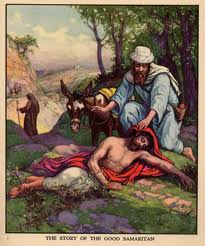
Here is a familiar story from Luke 10.

33 But a Samaritan traveller who came on him was moved with compassion when he saw him.
34 He went up to him and bandaged his wounds, pouring oil and wine on them. He then lifted him onto his own mount and took him to an inn and looked after him.
35 Next day, he took out two denarii and handed them to the innkeeper and said, "Look after him, and on my way back I will make good any extra expense you have."


There is much to learn from a careful study of the story of the Good Samaritan. You can look at the way Jesus made the members of his audience into the bad guys and a hated ethnic/religious minority into the good guys. Or why the religious people were the bad guys and the heretic the good guys. Or why Jesus, in telling this story, ignored the question he pretended to be answering. He didn’t, as we say today, “buy the premise” of the question. There is, of course, a premise underlying the answer, and we would be justified in wondering whether the lawyer who asked the question noticed that there was another premise available to him and switched over to it.

This post is not about any of those things and it is “about” the Good Samaritan only as a jumping off point. The question I would like to explore today has bothered me for some time. I suspect that is because there is no good answer to it. Here are three stories about the situation the Samaritan encountered.

Story I A Samaritan traveler came upon a victim of highway violence and, although he himself was vulnerable to the same threat, he had an emotional reaction toward the victim and stopped to help him. He administered first aid and took the victim to an inn where he gave instructions that the victim was to be cared for and that he, himself, would pay whatever it cost.
The victim was lucky, in a sense, because travelers didn’t come up that road all the time and not all who came would have stopped to help him. There are some very good reasons for not stopping, simple prudence among them. So even though the victim’s life was saved through the happenstance of a willing helper coming along before it was too late, we call it an uplifting story and name hospitals after the benefactor.

Story II Several versions of the story Jesus told circulated in Jerusalem and Benjamin, who knew the innkeeper, heard one of them and started thinking about it. Benjamin wasn’t a particularly sympathetic person and was not in any way a politically engaged person, but he was gregarious and well-known and well-liked. And while his innkeeper friend had an uplifting story to tell about the satisfactory recovery of his guest and the more than satisfactory profit he had made, Benjamin kept thinking that all the good of this story was just happenstance. What if no one had come along? What if the person who did come along just kept moving?
So Benjamin started talking to his friends at the Jerusalem Chamber of Commerce who had friends at the Jericho Chamber of Commerce and they came up with a plan to take some of the happenstance out of this trip. Could encourage tourism too, you never know. The plan involved the regular deployment of groups of five at hourly intervals, starting simultaneously from Jerusalem and from Jericho. Five was a big enough group to deter bandits and one of them would be armed, in any case. All were trained in first aid and carried packs containing oil and wine, with a total value of two denarii.

You can’t stop bandits from preying on travelers, certainly, but the regular provision of medical care and transportation is something that can be done. There is an organizational burden to it, of course, and finding enough volunteers is always a hassle, but Benjamin’s plan leaves everyone better off except the bandits. And, really, who cares about the bandits?

Story III. Simeon heard about Benjamin’s rescue brigades and rolled his eyes. He had been asked to serve on one of the teams and turned it down. He was polite to Benjamin, but that evening he quipped to his wife that the brigands were doing more for economic development than the brigades were. He liked that. It kept running through his mind and eventually it stopped running and just sat down. “Why spend all this time patching up victims when the brigands are just as much victims as the travelers? Has anyone given any thought to what kind of life this must be for them? Surely they wouldn’t choose such a life unless nothing else was possible for them.”

Simeon didn’t have any of the Samaritan’s compassion and not very much of Benjamin’s networking skills, but he did know some people in the unfortunately named Jerusalem Economic Redevelopment Commission. JERC had had some success in getting Empire Redevelopment Grants (ERGs) from Rome and would be open to a new idea.

The first grant enabled economic development planning for the area surrounding the route from Jericho up to Jerusalem. They were lucky on the third try. There was not enough rainfall for the proposed barley farms. There was not enough foot traffic for the proposed water slide. But there was a good deal of silver ore in the mountains. The subsequent grant enabled the establishment of several highly profitable silver mines, which were turned over to the former brigands on the condition that there were to be no more “accidents” happening to travelers.


The outcome pleased everyone. The authorities in Rome were delighted to have ended a source of public disorder in a notoriously volatile part of the empire and to have a source of silver for the denarius coins. The bandits were happy to exchange their marginal and violent life for a stable and prosperous one as prospectors, miners, and dealers in precious metals. The travelers were not pleased because they immediately forgot how dangerous the road was, but they benefitted nonetheless. Simeon was acclaimed by his peers and enriched by his share of the new silver profits—just the merest sliver of the profits; almost as low as a finder’s fee. Simeon’s wife was pleased because Simeon finally stopped telling the “brigands and brigades” story at parties.

True Religion and Undefiled

True religion and undefiled is to feel compassion for the widows and orphans as they are evicted from their homes to make way for an eight-lane expressway. James 1:27, Hess paraphrase.
These three stories make an odd pattern when you consider them together. The “best person” is without question, the Samaritan. He saw, bloody beside the road, not a hated enemy, but a wounded fellow traveler. He was “moved with compassion” and acted on his feelings with prompt, courageous, and generous action. Benjamin’s idea that there was no trusting of happenstance compassion and also no need to, is not all that praiseworthy. Simeon’s idea that he could get an ERG and change the economic climate of eastern Judea was insightful, but not otherwise meritorious.

If you consider this to be a story about compassion, you would rank the characters: 1. The Samaritan. 2. Benjamin. 3. Simeon.

If you consider this to be a story about improving life for everyone, there is no question that you would get: 1. Simeon. 2. Benjamin. 3. The Samaritan. The Samaritan saved the life of one traveler. Benjamin saved the lives of countless travelers. Simeon saved not only the travelers, but the brigands as well.

Theoretically, there is no reason all three characters can’t have all three traits. All three characters have the compassion of the Samaritan, the social skills of the networker, and the economic vision of the developer. Theoretically. Practically, we find that different people have different gifts and that not every economic developer has the compassion of a trauma nurse. That means that most of the time, we will have to choose one approach or another; we will have to valorize one kind of person or another. We will have to rank people by the good they did or by the acted upon feelings they had.

WWJD?

Jesus told his story to frazzle the lawyer. It’s a motive we can all understand. If Jesus were to make a choice among our three characters, there is no question in my mind that he would choose the Samaritan. And that’s the principal thing wrong with WWJD. The question any Christian of our time would want to ask is WWJHMD—what would Jesus have me do? The first thing, obviously, would be to buy a bigger bracelet. But after that, would Jesus—now our adviser, not an itinerant rabbi—want to begin with compassion? Would he say that actions that don’t begin with compassion are unworthy of his followers? Would he say that what Benjamin chose to do is a good thing IF and only IF is began with feelings of compassion on Benjamin’s part?


I hope not. I can imagine myself feeling compassion for a traveler. It is harder to imagine my compassion upon hearing a story about a guy with so little road smarts that he got himself involved in a nasty incident on the road from Jericho. If following Jesus means beginning with compassion, the travelers are the only ones playing the game.

Or would Jesus—the adviser, again, not the teacher—say that providing for the needs of hundreds of travelers is better than providing for the needs of one? Would he single out for special praise the people who have the ideas that benefit many people, even if their emotions were not engaged? Would he consider the hassle of maintaining the network of volunteers to be “faithful service,” or just a nice thing to do? Sweet, but secular. I can tell you that Jesus’ body, his church, is going to have access to the services it values. Services it needs but does not value are going to be outsourced and purchased. You can’t purchase compassion at all, but purchasing networking and volunteer maintenance is surprisingly expensive and all that money comes from the evangelism fund.

Or would Jesus take compassion on the brigands, and in that compassion, praise Simeon? Simeon doesn’t have any people skills at all, but he has vision and he has Imperial contacts. There are a lot of things he could have done that didn’t help anyone on that road—either the travelers or the perpetrators of violence. What he chose to do benefitted everyone and Simeon might be a religious man or not; emotionally engaged with his fellowmen or not. Would Jesus say that the mark of Simeon as a follower of his can be seen in his care for his wife and children, not with his use of his business contacts?

Valuing only compassion is like valuing only a sugar high. And then what?

Wednesday, April 13, 2011

The Assimilation Committee, Part 2

In the previous post, I told a parable about how committees work in my church. For the purposes of telling the story, I imagined that my old-line Presbyterian church was right next to a public housing project in Portland and that the residents of the project had begun attending our church, joining, and involving themselves in the work of our committees. That produced all kinds of difficulties for the chairs of the committees and even more for the Assimilation Committee, which had to solve this dilemma in principle.


I also said that the post was true in the way a parable is “true,” not in the way a newspaper article is “true,” and I promised to “interpret the parable” in the next post. That is today’s job. Let’s do the easy part first. All the descriptions of stylistic differences are actually true, but the parties about whom they are true are not “mature Christians” and “Project Rookies” of the parable. They are, rather, men (males) and women (females). The women are the “mature Christians.” The men are the “Project Rookies" and the work of the Assimilation Committee is a good deal more fundamental than I implied.


The picture below is typical of the man, looking at the "listener," but untypical of the woman, not looking at the speaker, according to the research Maccoby cites. That brings up the question of the source of the data. It is readily available. All the comparisons were taken from the first three pages of Eleanor Maccoby’s article “Gender and Social Exchange: A Developmental Perspective,” which appeared in Volume 95 of New Directions for Child and Adolescent Development, the Spring 2002 issue. As an outsider to sociology and as a fan of Maccoby’s through her many years of publication, I offer my judgment that her work is impeccable. She is a careful, thoughtful centrist on gender questions and a capaious anfair-minded user of research. All of that says only that when I read something she wrote, I am likely to trust it.


Let me offer a few passages from the cited article, just to let you see how close to her findings I stayed in my adaptation of those findings to the “Project Rookies.” One: “In mixed-sex groups, men typically talk more, give more information and opinions, make more task-relevant suggestions, and express more direct disagreement. Women in mixed-sex groups more often express agreement with other speakers, express group solidarity, and adopt a warm upbeat tone of voice.”


Here’s one more. This finding actually comes from comparing groups of men with groups of women, but for my purposes, it didn’t really matter. “In all-female groups, women devote an even greater proportion of their interactions to socioemotional elements of the exchange, displaying more friendliness and mutual helpfulness than is typical in all-male groups. Men are more likely than women to initiate negative acts and to reciprocate another man’s negative with a negative of their own, so that conflict escalates. Men more often engage in seriously meant oppositional discourse, in which they may highlight their differences and forcefully argue opposed points of view. Women are more likely to soften opposition, to make their views seem more alike rather than more different.”


Conclusion: women are nicer than men.


Now let’s translate this into the area of Christian praxis, where it appears in a strange and unsettling light.What do you think? Is it more reasonable to say that women are naturally better Christians than men are? You look at the listed outcomes of life in the Spirit—love, joy, peace, forbearance, kindness, goodness, faithfulness, gentleness, and self-control—and tell me.


Or, is it more reasonable to say that in God’s Providence, disciples who are men will (and should) act differently than disciples who are women? The implication here is, first and easiest, that a man who is living the life that the Spirit makes available will behave differently than he would apart from that life. Second, it implies that if there is “a man’s style”—leaving aside individual differences for the moment—it will be different from “a woman’s style.” Third, it implies that these styles may appropriately be referred to instrumentally rather than morally, i.e., we might say about “the man’s style” what we would say about a hammer, that it is good for hammering nails and what we would say about a saw, that it is good for cutting boards. We would not criticize the hammer as “concussive” or the saw as “abrasive.”


Is it really possible that the kinds of differences Maccoby describes—in a very different context and for different reasons, remember—are different resources for the Christian community? That they are more like different grades of sandpaper than they are like saints and sinners?


Yes. I think so.

Tuesday, April 12, 2011

The Dilemma of the Assimilation Committee

Caveat lector: None of the information offered in this post is true. Or if it is true, it is true in only an insignificant way. On the other hand, this post is entirely true, but its truth is the kind of truth a parable might have. It other words, it really is about something, but it isn't about what it seems to be about. The next post will discuss the implications of this one for the church.

At my church, the group that is supposed to see to it that new people become a functioning part of the church organization is called the Assimilation Committee. Assimilating new people into the mission of the church would be quite a daunting project, so we have chosen--either "instead" or "as a first step"--to integrate them into the structure of the church. You know, ushers, deacons, members of various committees and so on.

This is a much more manageable project, certainly, but even this modest project has its own difficulties. My church is a downtown church in an area that was once affluent. To simplify this description, I will say that we are next door to a large public housing project and that the residents of this project have begun not only attending our church, but actually joining and participating.

This is a wonderful achievement in the abstract, but this is a Presbyterian church, which means that we have a lot of committees. The committees have chairs who are supposed to manage the work of the committee and pass the results of their work up the food chain. That means that there must be results and the increasingly mixed membership of the committees--some mature Christians who have been in the church for a long time and some of the rookies from the nearby project--is a dilemma every chair must solve or there will be no product at all.

All these people are fine people I am sure, but their styles of interaction are not only different, but conflicting. In the contrasts below, I will refer to the long time members as MC = mature Christian and to the new members as PR = project rookies. It would be easy to find less offensive names, but since none of this is true, I won't bother.

1. In the committees' discussions, the MCs take the trouble to express agreement with the other speakers; they model a kind of committee solidarity; they maintain the sort of warm upbeat tone of voice that makes staying on task easier. The PRs, on the other hand, talk more, give more opinions, make more specific suggestions, and express a more direct disagreement with other speakers.

2. MCs do not make strategic use power when they have it; PRs are much more likely to use strategically any power they have and are, in addition, much more likely to be influenced by other PRs than they are by MCs.

3. MCs are a good deal more gentle (see Fruits of the Spirit, below). For example, they do not maintain direct eye contact with listeners when they themselves are speaking, but they do establish and maintain direct eye contact with speakers when they are in the listener role. PRs might be called more "visually dominant." They maintain direct eye contact when speaking and disengage from the speakers when they are listening. The effect of this difference is that the CRs sound tentative, as if unsure of what they are saying. Their speech overall has a polite and deferential quality. PRs tend to give their views in a more aggressive, chin-thrusting sort of way. If there is a way to be chin-thrusting and deferential at the same time, I have not seen it practiced in our committees.

3. Committees being what they are, negative things will be said from time to time. There will be disagreement, occasionally sarcasm; there will be interrupting and talking over others. The PRs are more likely to do any or all of these and are also more likely to respond to a negative action with another negative action. MCs are less likely to do any of these things: the interrupting the sarcasm, etc. They are more likely to ignore negative actions--simply not to respond to them at all--and to act positively in response to any positive action. Put yourself in the place of the committee chair and consider that for a moment.

4. MCs are more likely to highlight similarities and agreements. PRs are more likely to highlight differences and disagreements.

5. MCs are likely to refer to the committee's work, when describing it to a third party, as "our report." PRs are more likely to say "my report," especially when they are talking to someone of high status or more power in the church.


I could go on, but the problem as it appears to the Assimilation Committee is probably clear now. I would like to put this is a broader context, if I may, before sharing it. This list of the outcomes of life in the Spirit is one of the best-known passages in Galatians: "But the fruit of the Spirit is love, joy, peace, forbearance, kindness, goodness, faithfulness, gentleness and self-control." If you look without prejudice at the two populations of Christians in the work of the committees, you will see a lot of the outcomes of the Spirit in the participation of the MCs, just as you would expect, and a great deal less in the participation of the PRs, who are, after all, new.

I would like to remind you, using a different formulation than the one I used at the beginning, that the information contained in this post is true. It just isn't true in the way it seems to be true.

Saturday, October 23, 2010

Intramural Spitball Just Isn't That Interesting

I'm going to begin by quoting myself. I'm sure there's something wrong with that. I wrote the Pages (as opposed to the Posts) with the idea that they would be an introduction to whatever ideas I would post later. Let's see if it works. Here's a cut from my Page, "Christian Praxis."

TEAM The first is that Christianity is a team sport. Solitary Christians labor under extraordinary burdens. We need to be part of a team or an ensemble or a group in order to ask the right questions of ourselves. There are two such. The first is “are we winning;” the second is “am I playing my position the way it ought to be played?” I probably should confess that I like team sports and “team” is my own first language, but I intend these questions to be available to people who have other first languages, as well, so I will meddle in other metaphors, say, drama and music, as a gesture of good faith.

Today, I am making my first reference to a very good book, American Grace, by Robert Putnam and David E. Campbell. It is a sort of "sociology of religion" approach to contemporary America. I'll put the crucial paragraph here, but I want to paraphrase it myself, because I want to feature something that I think is only hinted at in the analysis. I think what they mean is that a substantial number of Americans have walked away from the current religious debates because they think the debaters are disgusting.

Putnam and Campbell say, in the Hess version of this paragraph, that the sexually permissive 1960s upset the cultural apple cart. This development in the 60s was like an earthquake and it produced three aftershocks. In the first one, it brought conservatives out of their self-exile from politics and made them part of a new and very powerful Republican movement. In the second one, it brought the liberals into the new cultural wars, where they played to win. In the third, large numbers of young people walked away in disgust.

An unprecedented number of young people, who might, under other circumstances have been interested in questions of faith and life turned out to have very little interest in ecclesiological mud-wrestling. There are now more people in the United States (17%) who say "none" when they are asked what religious tradition they identify with than there are mainstream Protestants of all denominations combined (14%).

In my view of the Putnam and Campbell narrative, the "nones" have an idea of what people do when they are committed to the kind of life to which their religious values point. The Nones know how hard it is to walk by an obnoxious opponent so that you can attend to the things you yourself feel are more important. Feeding the hungry, for instance, is more important than instigating a court suit to remove the religious exemption from the IRS file of an opposing church. Providing good prenatal care is more important than a constitutional amendment that establishes that the health of the mother really isn't a concern in abortion cases.

People who claim to be patterning their lives after Jesus of Nazareth just don't do that. So the Nones, who might really have been interested in what Jesus taught about being forgiven a huge debt and being, as a consequence open to forgiving a small debt, found no interest at all in what looks, from the outside, like an intramural spitball war. In this version, "none" means, "If it means acting the way THEY are acting, I don't want any part of it.

And why would they?

The good news for Christians is that what we might do to re-engage the Nones in the kind of life we think is worth living is to start living that kind of life ourselves. This isn't a call for Christians to be better people. This is a call for Christians to get their public priorities straight and to refuse to follow leaders who promise no more than beating up on your opponents.

In the excerpt from my Page, I said the first question had to do with winning. I still like that emphasis. But the "we" I had in mind was Christians and the "winning" I had in mind is doing what has to be done, in public and in private, in public policy and in private conscience, to follow God's call in our lives. I am aware that following God call is going to look like different things in different contexts. And by "playing my position," I meant that the things liberals do ought to make conservatives more authentic Christians and more effective Christians. And vice versa.

I'm not talking about "the evangelical agenda" or "liberation theology." Topics like that are like an offensive lineman asking why HE has to do all the blocking when the running back is going to get all the credit for the touchdown? The answer is that if you win, each of you gets the same ring.

Thursday, September 9, 2010

What Does God Want From Shy Christians?

“What particular use do you suppose God has in mind for shy Christians?[1] There ought to be something. I don’t think “shy” is a disease. I don’t think it’s a character disorder. Some people are just shy and if they are Christians, they are shy Christians.

Let’s begin by looking at what shy is going to mean in this piece. It doesn’t refer to people who have a psychotic hatred of or a neurotic aversion to people. Those are diseases and I’m not talking about diseases. It isn’t the stirring of a sense of self-consciousness and the mild anxiety that sometimes goes with it in stressful situations. Those are things that could happen to anyone, given the right situation; they aren’t the property of shy people particularly.

I’m inclined to say that I, myself, am shy. I hesitate to say so because the fact is that most people say they are shy, when they are asked. And also because I made a living being professionally gregarious at and around the legislature in Salem for many years. And also because I have chosen a career that involves standing before groups of people and trying to teach them about politics. And also because I have a daughter who described herself as shy when she was a cheerleader—a cheerleader!—in high school and I could not find a way to take her account of herself seriously. I am taking it seriously now.

I am going to follow my original inclination, however, and say that I am shy. I want to spend a little time saying what I mean by that and then a little more time trying to answer the question with which I began this post. It will take just a little extra time because I want to build the general case for gifts (see 1 Corinthians 12 for Paul’s take) and then apply it to temperament and character. Or, more exactly, to kinds of temperament and character.

So here’s what I mean by shy. I go into an unstructured situation not knowing what to do. I think what it must feel like to gregarious people—that’s what I’m calling “the other kind of people.” It must feel like an opportunity to meet new people or to exchange casual conversation with friends and acquaintances. It must feel like a party that goes on and on. I’m guessing. When I’m at a party, I try to find someone who really wants to talk about something—“talk about something” describes the kind of conversation, not any topic in particular—and go off into a quiet corner with that person and play with the idea until it’s time to go home. I tell myself I do that because I'm shy.

I also think gregarious people make different kinds of mistakes than shy people. Gregarious people are inclined to take more, in a conversation, than was offered and the people from whom that more was taken sometimes feel bad about it. Shy people are inclined to take less, in a conversation, than was offered and the people who saw their offer rejected sometimes feel bad about it. You noted the parallelism there, I trust. For every way of doing it right, there is a way of doing it wrong. For every temperament, there are jobs that belong particularly to people whose temperaments make them good at it. It's their job.

I like “largetalk;” smalltalk just doesn’t do it for me. (I am using both largetalk and smalltalk against the advice of my spellchecker, but when it objected to spellchecker, I stopped taking it seriously.) Besides, I’m no good at smalltalk. And the effort of it wears me out. I’m really tired afterwards and, usually, discouraged as well because I’ve done the job so badly. And I remember that it has been a long time since I remembered to take a deep breath. And I think there are a lot of people like me. I don’t know if that way of characterizing the experience I’m calling “being shy” has any resonance with you. I hope so, because it’s the best I can do right now.

Now I want to take a small theological detour. I’m going to play off of Paul’s chapter on “gifts,” where he says that everyone is given a gift that could be used for the building up of the group. I’m going to say that everyone is a kind of person. Every kind of person is better at something—shy people might have acute empathy with others, for instance—than another kind of person. Every Christian has the obligation and the opportunity, to be of service as the kind of person he actually is. Doing what you can do, acting in a sustainable positive fashion, is all one person can expect of another. It is sometimes argued that God expects more, but I have not yet been persuaded.

That’s how the system works. Everyone is diligent about doing what he can do. Everyone is appreciative of the people who do other kinds of good things. Both those contribute to the vitality and effectiveness of the group.

There are some exceptions I would grant. I am thinking of four in particular. The first is that every now and then, something needs to be done and you are the person who is there. The fact that the job to be done is “not your kind of thing” doesn’t really matter in this case. If it’s you or nobody, it’s you. The second is that this understanding does relieve you of the need to do the things that would be done better by others, but it identifies as crucially important that you do the things that belong to people like you. The third is that there are some things that now cause you great anxiety which, if you would learn to do them better, could be a normal and sustainable part of your repertory. And, finally, it is worth remembering that we are talking about shy today, but no one is just shy. People are shy and competent and insensitive and knowledgeable and naive and “having a bad day.”

That’s the theological dilemma and a four practical little buffers. Now that we come, finally, to the question of what God wants from shy Christians, we find it is already answered. There is always the possibility that this is my answer, not God’s, but let’s stop for a moment and remember whose blog this is.

The answer is that, under ordinary circumstances, God wants shy Christians to do carefully and well the work their shyness prepares them to do. No one is obligated, by virtue of being a follower of Jesus Christ, to be gregarious. At my church, they are careful to ask the congregation to “stand if you are able,” but we are not asked to "sing if you are able,” or to “make smalltalk if you are able.” (I have made smalltalk one word against the advice of my spellchecker.) We say that the coffee time after the worship service is “fellowship” and we call it “a good thing” because, after all, who is against “fellowship?” I don’t know. Who is against cocktail party conversation? The coffee time is stressful because it is about either meeting new people or talking intently to your friends so you won’t have to meet the new people. The new people really do need to be not only met, but welcomed. I hope very much that someone does that because if it needs to be done and no one is doing it, I am back on the hook again and for me, the costs are high.

I believe that every person has a gift to give, but in this post, I am arguing that every kind of person has a gift. If they give it, they should be supported by those of their friends who know what is going on. If they fail to give it, they should be criticized (helpfully) by those of their friends who know what is going on. But they will not be expected to do the things that will cost them a good deal when those things could be done by people who would consider them a golden opportunity.

The point I am about to make, the last point, is a very small-scale view of God’s providence. I know that Providence—that’s Providence with a capital P—is about larger things. I remember a remark that “Providence” is the word Christians use for history. But we do say that God provides, the Latin is providere, because God foresees; the Latin is pro = “before” + videre = “to see.” It is God’s ability to see what is needed that sustains God’s ability to provide what is needed.

Nothing in the Christian doctrine of Providence implies that I, myself, will see what is coming or what is needed in any systematic way. But the implication of this notion of providence is that there is a “fitting together” of the faithfulness of different kinds of disciples that makes the outcome of their service more than the simple sum of the work they have done.


[1] Shy doesn’t suggest everything I have in mind, but I think it is the best word overall. I have been surprised by how differently this question develops for me when I say introverted or reserved or private instead of shy. My mind simply takes different paths when I think of this dilemma using those other words. I have stayed with shy because it is a more colloquial word; essentially, a wider door. A door more people can get through and move on into the rest of the post.

Friday, August 6, 2010

Petty Coercion -3 Faith

This is the third and last trip to Marilynne Robinson's essay, "The Tyranny of Petty Coercion." (See the hyperlink to the full chapter in Petty Coercion 1) In 1 I followed her argument that "private courage" (my term) is so much more expensive than "public courage" because public courage is socially defined and valued. Private courage has to be defined and applied by the individual himself and each situation is different. In 2 I went back to look at politics and the courage demanded by a commitment to truth.

This time she wants to look at religious faith as an offense against comme il faut. I'm using the French expression both because she used it and because I had to look it up and also because it seems more nebulous and upsetting in French. Comme il faut can mean either "it is not necessary" or "it is not proper." In the present context, it means "People like us really don't do that."
"...do things like that" refers to Robinson's being a Christian. I'm going to take a little time with what that means because I like very much the way she puts it.
I have an attachment to the Scriptures, and to the theology, music, and art Christianity has inspired. My most inward thoughts and ponderings are formed by the narratives and traditions of Christianity. I expect them to engage me on my deathbed.
For me, there is a lot to like in that way of saying what "Christian" means for her. I like the three parts: "attached to the Scriptures,"formed by the narratives and traditions," and "engage me on my deathbed."
Robinson is a liberal, mainline Protestant. She does not "wear my religion on my sleeve." (Note that there are many Christians who think that "wearing my religion on my sleeve" is what courage requires of Christians.)

In any case, being a Christian in the way Robinson is turns out to be an offense against comme il faut. She does things she ought not do and neglects to do things she should do and the guarantors of "what one does" get on her about it.
Over the years many a good soul has let me know by one means or another that this living out of the religious/ethical/aesthetic/intellectual tradition that is so essentially compelling to me is not, shall we say, "cool." There are little jokes about being born again. There are little lectures about religion as a cheap cure for existential anxiety.
These little nudges wear on her. They are petty, rather than radical. But they happen over and over and nothing she says seems to slow them down. And they are so particularly irksome because they levy against her charges that her friends know do not belong to her; and also because the positions her friends are attacking are so much more vulnerable than the positions she actually holds.

That brings us to the question of what courage would require of any of us who are in roughly the situation Marilynne Robinson is occupying. Is it best simply to put up with the nudging and smile? Is it best to correct the parts that are just wrong and smile about the others? Would it be smart to join her friends in beating on the fundamentalists and then strenuously object when they turn to the kind of faith stance that means a lot to her personally?

It's not so hard to know what would be hard to do, but it is hard to know what it would be good to do. "Turning the other cheek" sounds like a good idea in some circumstances, but here you are "the religious person" and turning the other cheek is also turning the cheeks of everyone else in that category. It's hard to know just how Jesus would have felt about turning someone else's cheek.

Tuesday, June 22, 2010

Faith Seeking Understanding

“Faith seeking understanding.”[1] What a puzzle. But first a little throat-clearing. This seems to me a long post. It seemed to me a short to medium “essay,” but as I put it in the blog, it seems long. At the moment, there are 2171 words. I tried to break it up into several posts, but they are connected and I don’t want to start serializing like Charles Dikkens (the well-known Dutch author, thank you Monty Python).

So here is the idea. There are three parts. In the first, I tell the story of how I learned to hear the low trumpet/flugelhorn part in the march, The British Eighth. In the second, I identify the two relevant parts of that experience as “faith” and “understanding.” In the third part, I illustrate just how sticky that relationship between the two can be and end with a passing note on what the church is for. I thought if I said where this journey goes and pointed out that there are, in fact, rest stops along the way, that fewer of you would simply sign out and wait for a shorter one. The episodes can serve you as rest stops. That's how they served me.

Second throat-clearing. It’s hard to get really accurate about The British Eighth without distracting myself and all of you from the point I am trying to make. That’s why I didn’t embed a hyperlinked recording or paste in the first six measures of the score. So some of the “facts” about this march are just invented as a convenience. Is D the first relevant tone? Does the run end at D#? I don’t really know. Just call the music part “fiction” and I’ll get on with the story.

So. Where was I. Oh yes.

“Faith seeking understanding.” What a puzzle! And no prominent role at all for knowledge.

Today, I would like to tell you a story that has provided the context for most of my thinking about this in the last year. It isn’t, except by analogy, about religious faith, but it does set trust and experience dramatically at odds with each other and I want to tell you, it is not a comfortable experience.

Episode 1: The British Eighth March

Marilyn and I both played musical instruments. She was a virtuoso and I was good enough not to get myself thrown out any of the several bands I played in. But we had both played a lot of marches. A lot of marches. We took it upon ourselves, sometime back in the late 1990s to figure out what was going on in the first six bars of the march, “The British Eighth.” We had the Ohio State band’s recording of it to work with.

We listened to it over and over and couldn’t make it work. The trumpets doodle a little, (two measures)drop an octave, and they work back to half a tone higher than when they started (four measures) and they do it in eight notes. Let’s say that the ru begins on the D above middle C, drops an octave to the next lower D, then crawls back up: D, E, F, G, A, B, C, D. Oops. That’s my eight notes. That’s all I get and I’m not at E yet.

It’s a very common band phrase: flutes and clarinets do it all the time, which might by why Marilyn and I were so sure we were hearing what we knew what we were hearing.. This time it’s trumpets, or possibly, since it’s the Ohio State Band, flugelhorns. Two very experienced musicians who couldn’t account for what we were both hearing. Eventually we gave up.

Episode 2: Cold Case

Sometime within the last year, I decided enough was enough. This was a mystery that really shouldn’t be allowed to linger, so I took it on in a “Cold Case” spirit. I went to one of the most talented musicians I know, our church’s organist and choirmaster, Jon Stuber. We put the Ohio State disk in his player and he followed the trumpet line on his keyboard. It didn’t work. He could tell what the pitches were, but he couldn’t get back to D# in eight notes.

So he called in our mutual friend, Ann van Bever, who is, among other things, the best oboist I know. Jon explained our dilemma to her. It starts here and drops an octave and gets backto D# in eight notes. She listened to it once. She said to Jon, “What do the trumpets do?” He repeated it. We listened again. “No,” she said, “They don’t do that.”

She said that as an oboist, she had played a lot of marches and had learned how to hear them. I remembered at that point that I had gone first to a church organist. What they actually do, she said, is drop to the low D, then drop further to C, then make the run up to thefinal D#. Jon said, “OK, let’s listen to it again.” I said, “No, it can’t be.”

So we listened to it twice more. Not the dozens of time Marilyn and I had listened to it. Yup. We all heard it the same way. D, then C, then the run, ending where it was supposed to end. In just eight tones. I went home a bemused and happy man.

It almost goes without saying that I put that disk in the CD player on the way home, mostly in celebration of a problem resolved at last. I wasn’t much of a celebration. I heard it just the way I had always heard it. I “heard it,” that is to say, in a way that is not really what they were actually playing. And by that time, I , I knew they were not playing it that way.

The solution, in any case, was straightforward. I played that track every time I got into the car for several days. I instructed my mind to hear it in the way I knew it was, despite my continuing to hear it the way it wasn’t. Hearing it truly flickered for a little while; now on, now off. Then it stopped flickering. Itcame on and stayed on. I actually heard it the way it actually was. And, if I am careful, I still hear it that way. And eventually, I won’t even have to be careful.

Episode 3: And your point is…..?

Remember that this is a reflection on faith seeking understanding. The people I have been reading and listening to recently have been pushing for a notion of faith that has more the flavor of trust. I am attracted by it; I am trying it out. I have someone who says the music goes like this when my own experience tells me it goes like that. On the other hand, my experience is ineffective. It doesn’t solve the problem I know I have. That’s the dilemma.

What I could do is to trust Ann. I could, in language I am more familiar with, “have faith in Ann.” That means that I refuse to do, in this case, what I do in virtually every other situation in my life, which is to bring the views of another person to the bar of my own experience and see how it fits. In this case, I would be rejecting my own experience and trusting someone else. But what the heck, right? It’s just a piece of music, right?

Let’s imagine the same dilemma in another form. I visit my parents-in-laws. I’ve had three complete sets of parents-in-law, so I can use this example without pointing the finger at anyone. My father-in-law hates me. He is belligerent and aggressive and sarcastic. Not so, says my wife (three of those too, of course) in this unspecified example, “He is a shy man and he is intimidated by you. He isn’t really being mean; he is just trying to get comfortable with you. Just respond in a friendly way and all well be well. Eventually.”

. “Faith seeking understanding” might have stuck you as a little abstract. The father-in-law who is so obnoxious is not abstract. I know what he is doing and I know why. I tell myself that I have experienced both the “what” and the “why” even though some academic part of my brain knows that you can’t really experience “why.” That means I also know what the effect will be of my playing nice with him. It is three more days of being his piƱata. I don’t think so. That is Lemma ! of the di-lemma.

Or, I could trust—I could have faith in— my wife. That is Lemma 2 of the di-lemma. I could privilege her experience and her understanding. I could try to hear in her father’s manner what she is hearing rather than what I am hearing.. I could discipline my own experience so that it reproduces in my own mind, what her experience is. I could, to refer back to the British Eighth, “try to hear what Ann is hearing.”

Episode 4: Finally. Faith Seeking Understanding

Which brings to the last two points, the first of which offers a more conventional example (religious) of faith seeking understanding and the second of which speculates about what the church is for.

Many times, when I was young, I stood in church beside my father and listened to him repeat the parts of the Apostles’ Creed he agreed with. He would have said, “those parts he understood,” but he was a gentle man. I heard the Creed go on then off then on as if Dad had a loose wire. What does it mean to say that we believe Jesus “descended into hell.” Or in the confession based on Philippians 2: that every knee shall bow, in heaven and on earth and under the earth. Under the earth? The sound came on; then it went off.

Dad had his own reasons and chose well from the options available to him. But the options we are considering today were not available to him. Dad’s cosmology made “under the earth” a silly thing to say. Dad’s Christology made “descended into hell” incomprehensible. To the best of my knowledge, he didn’t know what “the church” had meant by saying those things across the centuries: all those scholars and mothers and mechanics. He had his way of looking at the world to guide him. He would have called it his integrity. He felt that if he gave that up, he would be giving up everything.

Now you see why I started with the trivial example of The British Eighth. It gets harder. Giving up the way Marilyn and I heard the flugelhorns was something I could do. More specifically:
*I could withdraw my consent from the way I heard it.
*I could decide that I was hearing it in error, even as I continued to hear it that way.
*(Having faith in Ann made a new choice possible for me. )
*I could believe that reality was the way she heard it; not the way I heard it.
*I could not only withdraw my consent from the way I was hearing it, but I could give my consent to the way she heard it. And,
*I could do that, could give my consent, even when I couldn’t hear it that way myself..

So how does faith seek understanding. Well, I could, in the same way:
*withdraw my consent from the objections I have learned to make to the creeds.
* I could give my consent to another way of hearing the creeds, even if I am not at the moment able to hear them that way.
*I can tell myself what I believe (what I am trusting) the truth to be and instruct myself to see it that way. Even for the British Eighth, it didn’t happen right away. But I kept trying to hear the truth and eventually, I did.

The last light touch is on the question of what the church is for. In the example I have been playing with, Jon and Ann and I are “the church.” We are listening to the same music. Jon and Ann are “the church” for me. As I stand there with them, knowing what they are hearing, I can hear it. But I am new at hearing that and very experienced in hearing something else. So when I go home and put the CD on, I can’t hear it. I have lost my sense of what they are hearing. I’m not denying it. I’m still remembering what we all heard. But by myself, I can’t really hear it..

That worked for Jon and me because we had faith in Ann. Can I have faith in “the church?” Are there things that all Christians though all the ages have said to be so? Have they come, after years of work, to experience on their own the reality they have trusted? Is that what the church is really for? I have no idea. It does seems worth asking, though, doesn’t it?


[1] Augustine. Also Anselm. I am reminded of it every time my copy of The Christian Century comes in the mail.