Wednesday, December 15, 2010

Close Encounters of the Third Kind

Bette and I asked some friends over to watch Close Encounters of the Third Kind with us. If you can separate Christmas movies, like A Christmas Carol and Miracle on 34th Street, from Advent stories, Close Encounters is my favorite Advent story.

What's not to like? In this story, it's Joseph who gets "pregnant." I put that in quotes because it is a vision, not a fetus, that is emplanted in Joseph, but the implications expand until they drive out everything else in his life. Including his wife and kids. And when you stop to think about it, what do we know about the other couples Joseph and Mary hung around with?

This vision has three parts. It is a representation of Devil's Tower, in Wyoming. It is a sense that this picture means something. It is a sense that the meaning is crucially important. That's it. And for that, Joseph gave up "normal life." That all sounds biblical to me. Except for Joseph being the one who got pregnant, and that's not as different from Matthew's account as it is from Luke's. Richard Dreyfuss plays Roy Neary, the Joseph character; he's wonderful.

The Wise Men get the message too--in earth coordinates. They are Wise Men, after all. But a lot of "potential wise men," like the pilots of the planes that see the alien ship as clearly as could be asked, think that telling what they saw is way too much trouble. And it might alert Herod.

Herod is the U. S. Army in this movie. They protect the Wise Men and help them get to the place of meeting. But then they use "security concerns" to control the guest list by getting rid of as many of the shepherds as they can. The chief Wise Man protests, "Major Walsh, this is not your party. These shepherds are here by invitation and you have no right to exclude them."

The shepherds are marvellously unreliable as witnesses. They are too old or too young or "unreliable looking." If you haven't noticed the delightful irony that in Luke, the shepherds were the only ones who were told the whole story because they were the only ones nobody would believe, then you have still before you one of the great jokes of the Bible.

I love all that. But there is a special place in my heart for this story because my daughter Dawne made this picture for me. This shows the special U. N. reception area that was set up to receive and understand a message from far beyond their understanding.
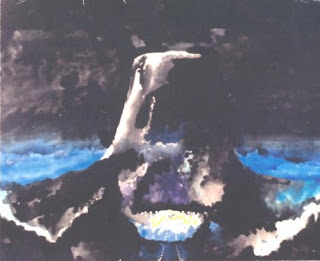

She made it by running that scene--I call it the "Little Town of Bethlehem" scene--over and over, putting the picture on pause and painting it in oil. Bless her! I had copies made and sent it out as a Christmas card once, years ago.

Here's a poem I sent out with it.

It is in the dark months; these months
That we are given the chance to notice
That the most glorious of all our almost denied hopes
Is really true.

The poem isn't everything I wanted it to be, but it does capture how completely preposterous the story of Advent is and how much less attracted to it we are than we might expect. That's what the line about "our almost denied hopes" is about.

Tuesday, December 14, 2010

The Redeemer, "redeemed"

I want to see if I can get the tone just right for this question. Why did Jesus' parents take him to Jerusalem when he was about a month and a half old? I'm trying for the tone of "Why did the chicken cross the road?"

I want to be careful about the tone because for this question the way is strait and few there be that find it. Some diverge, for instance, to consider how very little Luke knew about Jewish customs. OK so he got some of the customs wrong. Is that really a big deal? Or that he got into a cut and paste action from the birth of Samuel, the judge, and didn't quit in time. Or maybe there was a story about John the Baptist that was modeled on Samuel and Luke ran across it and appropriated it for the story of Jesus. Those aren't big deals either, unless you are treating these stories as if they were biography, rather than the myths that have collected about the founder of our faith and which are important to us only because the founder is important. These stories, in other words, would be exactly like the stories about Zeus--if we were Zeus worshippers.

OK, why did Jesus' parents take him to Jerusalem? Let's start at another place--just one more time--and then I'll answer the question. I love this question. It's new to me and I'm just enjoying the hell out of it. The other place is Luke 24:21. Jesus is walking along with Cleopas and a friend to Emmaus. They didn't recognize him and he didn't declare himself. Cleopas and the friend are in despair because Jesus had been crucified by the Romans, but it isn't Jesus' fate they are lamenting at the moment, but the death of their hopes. They were among Jesus' disciples and they had had hopes about what "the Jesus movement" would mean. Those hopes died when Jesus died. "We had hoped," says Cleopas, "that he was the one to redeem Israel."

It had looked to Cleopas and many others as if Jesus would be "the redeemer" of Israel. Which takes us back, for the last time, to the question of what Jesus was doing in Jerusalem as an infant. The answer is that his parents were redeeming him. And why did he need to be redeemed? Because he was a first-born male (see Exodus 13:1 and 13:11ff) and they took him to the temple to "consecrate him" to God's service.

The original idea was that God earned the services of all first-born males by passing over them when he was slaying all other first-born males in Egypt. In return, these little boys would spend their lives serving God in some special way, perhaps as a priesthood. But the tribe of Levi eventually took over the priesthood (Jesus dealt with the Levites through all of his ministry, you will recall). This change was reflected in a provision that the child could be "bought back," i.e., "redeemed" for five shekels. As near as I can make it, that's about $170 U. S. dollars. (see Numbers 18:15--16 for the original provision.). That would be a lot for parents who couldn't afford a lamb (Luke 2:24) and gave, instead, the poor person's offering of two pigeons.

There would be a glorious symmetry if Jesus would have had to be redeemed so that he could be the Redeemer. I think it is that thought that first tickled my imagination. In fact, the ministry of Jesus would not have been different in the smallest degree had his parents' not consecrated and then redeemed him. It tells us a lot about the parents and it lodges Jesus firmly within the tradition of the Law, but he lived a life of complete consecration to God in any case so from a theological standpoint, it really doesn't matter.

It was fun, though, wasn't it?

Saturday, December 11, 2010

Students Know When They Are Being Well Taught?

Some do. Some don't. Neither of those propositions is on my mind today. Today's question is this: will the students say what they know and will the result be better teaching?

There was a really interesting piece in the New York Times this morning. It begins with the interest the Bill and Melinda Gates Foundation has shown in locating good teachers. They have devised a "value-added" metric, by which they statistically calculate how much of a student's test scores can be attributed to particular teachers. A student of mine told me last week that in Los Angeles, these scores are printed in the newspaper next to the names of the teachers. I haven't verified that, but I find it plausible. Horrifying too, of course.

The new interest from the Gates Foundation is to see what other measures correlate with high value-added scores. They have discovered that you can ask the students. That seems obvious, I guess, but I began by observing that some do (know) and some don't. Here are three such observations.

Classrooms where a majority of students said they agreed with the statement, “Our class stays busy and doesn’t waste time,” tended to be led by teachers with high value-added scores, the report said.

The same was true for teachers whose students agreed with the statements, “In this class, we learn to correct our mistakes,” and,

“My teacher has several good ways to explain each topic that we cover in this class.”

This is information worth having and it can not be collected by having an administrator drop into the class, as if by parachute, jot a few notes and leave. The students know things like this and they will safely tell you provided the questionnaire is anonymous and is not used to evaluate the teachers.

Oops. We have just reached the brow of the hill and are peering down the slippery slope. I don't see any vegetation down there and it has been raining for a week. What are the chances we can keep our footing? (Here in Portland, it actually has rained for a week and there are months yet to go.)

When the answers these students provide are used to discipline or to reward teachers, to promote or demote them, to hire them or fire them, the students are presented with a new set of choices. I don't mean to cast aspersions on the students, but this new choice is a challenge routinely flunked by congressmen, judges, and White House staffers.

The choice is this. Do you want to say what you know or do you want to produce the kind of effect your assessment could produce? That's the question I had in mind when I started; that's what's on my mind today. Let me phrase that in a few other ways. Dear student: do you value the accuracy of your observations more than you value seeing justice done in your school? More than you value the chance to retaliate against the teacher whose homework you did all last week instead of going to the coast with your family? More than you value that chance to hurt the teacher who had one of your friends suspended from school last month?

Dear student: do you really think the administration is going to make good use of the information you provide them? Will they not, rather, put this information to their own purposes? Don't you think you can trust the clout you have right now (in answering the questionnaire) more than the clout some administrator might have in using the results for good purpose?

The question for these students, in short, is this: will you be willing to tell only the truth you know rather than trying to have an effect of some kind? The question for the Bill and Melinda Gates Foundation is this: do you really think students will continue to tell you what they know after you have put into their hands a tool that will allow them, instead, to get what they want? Do you really?

I don't.

A decade or so, the legislature in California began a program of sending cash awards to high schools with high (or with rising) achievement scores. The students at some schools began meeting with the administration to talk about what the money would be used for, should it actually arrive. In a number of cases, the administration's vision of the best use of the funds did not match the vision of the students, who were thinking that a day at Disneyland would be really cool. And, since the students controlled absolutely whether the scores would be high or not and since they personally paid no penalty for low scores, they were in a perfect place to blackmail the school. Which they did. And after enough schools did it, the Assembly suspended the program--probably over protests from Disneyland.

Have we taught our students to tell "the truth they know," to admit that there are some important truths they do not know, and to walk past all the inducements of power and influence? It would be nice to think so, but I don't. And until we do, this lovely new source of information that the Gates Foundation has given us will remain a small candle in a very large dark room.

Monday, December 6, 2010

Santa Claus v. The Heavenly Host: Part XII

I remember how hard it was for me when the Christian fish symbol was taken over by creationists and I had to give it up. You know. This one.


I really liked that fish. It was a First Century symbol used by Christians and it was a handy little acrostic of Christian doctrine.[1] But I came eventually to feel that no matter what it meant to me, what it meant to everyone else was something I didn’t want to be part of. The Creationists took it over and now it means “Creationist and Proud.” to everyone else. Not on my bumper! I’m starting to feel that same way about Christmas. Well, I’m not starting. It’s been going on for a while. But it is getting steadily worse.

So I’m giving up Christmas as something to care about on its own. I have nothing against presents and eggnog and Christmas trees and Ho Ho Ho, but I don’t invest in them either. More and more, it is Advent that moves me. Nobody’s going to make a lot of money at Advent, probably, or at least not enough for them to start pushing it up before Thanksgiving.[2]
With that distinction made, I have found my way to some questions that have interested me for a while, but which seemed…oh…divisive. Not really part of the spirit of the season. But they really are divisive and are fully a part of the spirit of Advent. So, I’d like to think about that division a little and I would be glad for your company.

Stan Freburg did a little skit many years ago called “Green Christmas.” It was funny, but it was also a protest about the commercialization of Christmas. Mr. Scrooge, the Chairman of the Board, couldn’t see what the point of Christmas was if it didn’t move the merchandise.[3] Bob Cratchit, who runs “a little spice company over in East Orange, New Jersey," protests. He just wants an ad that says, “Peace on Earth, Good Will to Men.”

It’s a heart-warming sentiment, but is foreign to the Advent story Luke tells. If you consult people to whom the language matters and to whom the intention of the author matters, it is less a jolly inclusiveness and more the beginning of a tempestuous and cataclysmic ministry. I’ve been reading Raymond Brown again this year (The Birth of the Messiah, but just the half about Luke) and also Joseph Fitzmyer, author of the Anchor Bible Commentary on Luke. They both say that the message of the angel went like this.

“Do not be afraid. Look, I bring you news of great joy, a joy to be shared by the whole people.”

The “whole people” the angel has in mind is Israel. God’s people. What it means for any other “peoples,” the angel doesn’t specify, but “the nations” (everyone else) is not what the angel has in mind. But there is more. The angel isn't done yet.

Glory to God in the highest Heaven
And on earth, peace for those He favors.

We could have a discussion about whom God favors, I guess, but it doesn’t seem to be everyone. It isn’t Cratchit’s “Peace on Earth, Good Will to Men.” Not quite “the Christmas spirit”. But oddly, it seems to be entirely in keeping with Luke's notion of Advent.
We might get a further clue by looking a Mary’s response to the greeting of Elizabeth. This is the justly famous Magnificat. Here is the part I was thinking of.

…the Almighty has done great things for me,
Holy is His name
And His faithful love extends age after age to those who fear Him
He has used the power of His arm,
He has routed the arrogant of heart
He has pulled down princes from their thrones and raised high the lowly,
He has filled the starving with good things, sent the rich away empty

So Mary—where we got the notion there was anything “mild” about her still mystifies me[4]—celebrates God’s faithful love in his routing of the arrogant of heart (Brown has “He has scattered the proud in the imagination of their hearts.”) and in pulling down the princes and in sending the rich away hungry. Ho Ho Ho. This is good news, truly, for the lowly, who are raised high and who are filled with good things. No shortage of Christmas spirit there, I guess.

Old Simeon was at the temple in Jerusalem when Jesus was circumcised and presented to the Lord as a first-born. He embraced the baby and proclaimed the lines we call Nunc Dimittis. Then he has some words for Mary.

Behold, he is set for the fall and rise of many in Israel
And for a sign to be contradicted—
Indeed, a sword will pass through your own soul—
So that the inmost thoughts of many may be revealed.

On the one hand, that doesn’t sound as vindictive as the quoted lines of the Magnificat. On the other hand, it cuts right to the heart of Jesus’ ministry. “Set,” in this passage means “set as a foundation stone is set.” Maybe builders have a technical word for that. This is the stone over which some stumble and on which others will build.

The child is set “for the fall and rise of many in Israel.” Some will rise; some will fall. It wouldn’t be too far afield to imagine that those who will fall will not be entirely entertained by the experience
.
The child is a sign to be contradicted (Fitzmyer translates, “A symbol that will be rejected.”) Fitzmyer’s choice of words calls to my mind Isaiah 53:3, “He was despised and rejected of men,” but that may be only because I have been listening to Handel’s Messiah for the last week. I don’t know what it brought to Luke’s mind.

These inmost thoughts that Simeon referred to are “bad thoughts, doubting thoughts, vain thoughts” says Brown on the grounds that all thirteen uses of this word in the New Testament (the word is dialogismos) are pejorative. The rejection of this sign will, Simeon says, reveal the inner anger and rebellion of many. And the truth is, you don’t have to read much farther in Luke to see that beginning to happen. In fact, Luke 12 would be a good place, where Jesus says,

"Do you think I have come to bring peace on earth? No, I tell you: rather division; for henceforth in the one house of five they will be divided, three against two and two against three. They will be divided, father against son and son against father, mother against daughter and daughter against mother.”
We don’t know what old Simeon saw, but if he saw the vision contained in that saying, you can see why he wanted to have a word with Mary privately. In short, the Christ Child is not good news in the same way that Santa Clause is good news. Or Frosty the Snowman or Rudolph the Red-nosed Reindeer. But the texts are there and they say what they say. It doesn’t seem quite right to ignore them. Not at Christmas.

[1] For the record, the Greek letters spell out icthus, or “fish.” and can be read as “Jesus Christ, Son of God, Savior”.
[2] Bette did remind me that if you are going to buy an Advent calendar, “before Thanksgiiving” is the only sensible time to do it.
[3] It almost goes without saying that Freburg himself played Mr. Scrooge.
[4] It does rhyme nicely with “child,” which is probably why it is used.

Sunday, December 5, 2010

Free, Equal, and Dependent

Independence is the goal of childhood. Interdependence is the achievement of adulthood. Dependency is the nightmare of old age. Is there any way to do this very hard task, well?

Caveats and Yes-buts I have something I’d like to talk about. The goal of this section is to help you let go of some other emphases, even very plausible ones, and come along with me on this trip. First, I know it is true that dependency happens to young people as well as middle-aged and older people. Second, I know that there are caregivers who are more dependent on giving than the receiver is on receiving. Third, I know that what looks like a one-way dependency on the surface is often a two way dependency—not a true interdependence—when you get below the surface. And last, I know that a lot of people who face this dilemma will not have a good marriage to fall back on.

OK, having said all that, what about being permanently dependent on another person? It is true with this question, as it is with many difficult questions, that an easy and very good answer can be given. This is true in the same way that putting the ball in the basket is easy after four or five difficult and well-executed passes. The trick is in the passes, not in the shot. So the trick is in the relationship, not in the dependency.

So here is the answer that seems to me easy and good.[1] I had my closest approach to this topic when Marilyn, my wife of many years, suffered two very hard years of cancer and cancer treatment. These “easy” answers draw on that experience and on our conversations at the time.

Rule one: You can’t pay for your care with gratitude. The dependent person gets a lot of care and doesn’t give any care. She—my reference point is Marilyn, but I really believe this would work either way—will be tempted to see how much it costs the givers to be there and do all the things that need to be done and to respond with expressions of gratitude. “Gratitude” in that way becomes the coin with which she “pays” the caregivers. Gratitude is a feeling and there is nothing wrong with expressing it when you feel it, but you get the care you need when you need it and there are lots of reasons you might not be feeling grateful. Saying how grateful you are when you are not feeling grateful gets toxic pretty fast.

The question now is how the dependent person can learn not to pay in gratitude. She must know first, that if she gives in to the temptation, it will be worse for everyone. She must also know that gratitude is not expected. The service that is provided by the caregiver in a good marriage is entailed in the marriage. That what the “in sickness and in health” language is there for. It is not a contract; it is a reminder. This is not, however, the kind of adaptation that can be developed when it is needed. If this mutual respect has been a part of the relationship when both partners are whole, it will be easier to adapt it to the relationship when one is not.

Rule Two: The caregiver knows enough not to expect expressions of gratitude. He knows it is a pleasure to express gratitude when one is feeling grateful and is onerous to express it when it is only an obligation. So he is careful not to seem, in what he does or what he says, that he expects such expressions. This leaves him free to enjoy them when they are offered and free from expecting them as a matter of course.

The marriage is a mutual commitment. It means that the well one cares for the sick one. It is the luck of the draw which one of you develops the cancer or has the stroke or whose memory starts to slide. When I was doing this, I developed a metaphor that not everyone likes, but it brought some clarity to me and I still like it. It is that the marriage is like a meal in a restaurant. You pay for the food and for the preparation and for enough service to get the food from the kitchen to the table. When they agreed to serve you a meal and take your money, they took on that obligation. But, in fact, everyone one of us has been served, at one time or another, by a server who had some sense of who you were, as diners, and what would make your meal more enjoyable. It is a great pleasure to tip those people by way of saying thank you.

So in the marriage. All the care the caregiver offers is part of the marriage the way the price was a part of the meal. And if the partners both look at it like that, it enables the receiver to express gratitude where it was not expected and the giver to receive it with surprise and with great joy. That arrangement is the A game of a lot of couples, but you don’t always play your A game. Sometimes you are tired. Sometimes you are distracted. Sometimes you are in pain or fighting off despair. This metaphor reminds you where you want to be and for that reason, it is especially important when you have failed in the task to which you are both committed. Being reminded helps both of you remember what you want to do. It is a great help.

Rule Three: Be the Partner. Finally, both the giver of these services and the receiver need to know that there is only so much the giver can do. It is tempting to hold onto the job yourself, even when there are others who would be glad to help. It is tempting to do more than you should and in that way, you slide over into resentment. You might think you are hiding it, but resentment is a strong signal and the person who receives the care is a very sensitive receiver. She will know.

Again, the practicalities of finding the help you will need may be daunting, but the simple clear realization that you will need help is easy. The fact is that the person you are caring for needs a partner. She needs a partner more than she needs a caregiver. When you have burned yourself out “caring for her,” who will be her partner? Looked at in that light, all that “selfless behavior” which cost you so much seems only selfish and shortsighted. There are things only you can do for your partner. Do those. Someone must see to it that the whole collection of her needs are met. That’s your job too. But a lot of other people, some family, some friends, and some professional, need to be a part of this show. You don’t need to do all the caring; you need to do all the planning.

And for the rest, you need to be for her the partner only you can be.

The older I get, the more I appreciate the truth of the saying, “Growing old isn’t for sissies.” Many of these things are hard, hard, hard to do. But they won’t get done at all if the ideas aren’t in place and if there is a manual for how best to love the actual person who is your partner, I’ve never seen it.

[1] I want to keep “easy” in my formulation, but I’m not really an idiot. I know that “easy” refers to knowing what to do, not to the process of doing it.

Sunday, November 28, 2010

Just a Little Paranoid

I want to ask a question first. I want to ask it as open-mindedly as I can and that means posing it first because when I start writing about language, I get engaged and that wide-open mental aperture shrinks to the size of a pinhole very quickly.

Let’s put the question narrowly first. What is paranoia? It is, first, a term of psychiatry just as psychosomatic once was. We all saw how that one turned out. “Is it real, Doc, or just psychosomatic?” Paranoia is a mental disorder characterized by systematized delusions as of grandeur or especially of persecution.[1]

If you listen to words, and you probably do or you wouldn’t be reading this, you have heard people say they are “a little paranoid.” I have never heard anyone say that a person is “just a little sociopathic” but if he did say that, it would put the meaning in the same tension with the word that paranoid does.

If we want to talk about the array of words that might show up on the path that led, at its very end, to paranoid, we find that there are a lot of them. A person might be said to be troubled or dubious, or shady. He might be suspicious, or wary, or even fearful. But we don’t want that. We want to take the word at the end of the line and say we have just a little bit of it.

Why do we do that? Don’t know any of the other words? I don’t think so. We use all those words in other contexts. I think we want the pop of the big one—I’m PARANOID—but just the meaning of wary. Is it like getting cranberry juice concentrate and adulterating it with water? Or is it like getting battery acid and diluting it so it is not quite at full strength?

In Oregon recently, there was a political ad opposing something or other and using the slogan, “It’s too extreme!” Hello? Extreme means the very furthest away, the “furthest out,” we might say. But “too extreme?” What does that mean? Would an advocate say, “No, no, they are just saying that to frighten people; actually, it’s only moderately extreme.”?

There is probably a word for words that have that function. I call them “polar words” because they occur only at the pole (the very end) of the range of meanings. You could say that someone is nearly paranoid, I guess and you might be able to say that something is “nearly extreme.”
But those aren’t the only kinds of words where this problem pops up. People don’t use unique as a sliding variable term because they don’t know any others. Anyone who listens or reads comes across “very unique” as if unique meant “different.” Unique mean that there aren’t any others like it.[2] Unique is a polar word. It represents only the very end of the continuum. Is unique so valuable that people draw against it by using it where “different” would be correct? Does calling a new kind of cracker “a little big unique” help sell crackers?

This week, I saw an ad for something—it might have been a new phone—that said they were becoming more ubiquitous all the time.[3] Of course, if it is ubiquitous, there is nowhere else for it to be. Is this like unique and paranoid in that there is a certain pop you get by using the polar terms, even if you have to cut back on the actual meaning? It’s hard to think so. Does ubiquitous have a lot of pop?

Some gentle soul is going to say it is just ignorance, but you notice that all these deviations from established usage move in the same direction. These are not random changes. This is a substantial portion of American English which is being moved in a particular way. That way is that terms that were once “end of the line” terms are now being used as “anywhere along the line” terms.

Which brings us to the question I promised in the first paragraph: Does this really hurt us? Probably not. It is painful to people, like me, who were trained to respect such terms. It is not just their meanings, but their existence as polar terms at all. If all the terms that were once polar, standing at the ends of the axis of meanings, become relative so that they can legitimately be modified by adjective phrases like, “a little,” or “a substantial amount” or even “excessively,” which imagines a “just right” meaning somewhere in the center and says this one is too far out? I don’t think so.

I think people like me—in my previous essay about my perspective on language, I called myself “Conservative and Proud”—will probably serve the language by pointing out what is going on and by raising the question of whether the language suffers (and thereby, all its users suffer) by this new kind of language. So I offer this essay as a reflection on a kind of change I see taking place and I ask whether it is a big deal or just an irritation.

What do you think?

[1] The etymology of a word often adds depth to its array of meanings. Paranoia occurs in a mind, nous, that is para, “beside” itself. We say a person is “beside himself” with grief or with anger, but that just shows that an etymology is not the same as a meaning.
[2] And for those of you who have a theological appetite as well as a lexical one, the Greek monogenēs, which the KJV translates “only begotten,” also means “unique” rather than "only." Isaac, the son of Jacob was monogenēs and had a brother, Ishmael.
[3] The word we could really use is ubiety (yoo-BY-i-ty), which means “the condition of being in a particular place.” This emphasizes its “whereness.” Ubiquitous, by contrast, matches ubi, “where” with que, “any,” giving us not “anywhere,” but “everywhere.”

Friday, November 26, 2010

On Reading a Really Good Book

The book is Aftershock: The Next Economy and America’s Future, but this post isn’t really about the book. It is specifically about my reading of the book and more generally, it is an example of what I called, on my Page, “strategic reading.” I should remember to say that I have not read any more of the book than I have either included or pointed to here. I will read it all, I am sure. Reich is a delightful writer and his argument strikes me as urgently important. He also has a blog, by the way. http://robertreich.blogspot.com/.


Furthermore, and this is more to the point of this post, knows how to organize a book. I took a look at his comments on how the current distribution of income violates “the basic bargain,” and turned to the index to see what there was under “basic bargain.” This is what was there. It doesn’t take much to see that in the three bold and asterisked headings, the basic bargain is defined, revoked, and restored. So I read those three sections and called it good.

basic bargain
economic growth and, 75—76
historical and conceptual evolution, 29—31
need for restoration of, 64—65, 75
in post—World War II prosperity, 42—43, 45—46, 51
*principles of, 28public understanding, 59—60
*revocation of, 55—57*strategies for restoring, 128—40
*strategies for restoring, 128—40

It doesn’t take a lot of smarts to do that. I have been thinking about that because we are now approaching the tenth and last week of the term at PSU and my students are beginning to complain about the huge reading assignments. I have no sympathy at all for their complaints. When I assign long readings, I specify exactly what I want them to get out of it. My favorite metaphor is that there is a trophy in this reading somewhere. “Go in. Find the trophy. Grab it and leave. You’re done now.”

The students who learn to do that have learned a valuable skill and have preserved time for their other courses. The students who, on moral grounds—I just isn’t right to treat a text like that—refuse, have made the academic hill steeper. Those who initially can’t do it right away get repeated instruction and many examples. If, after that, they still can’t, they need to take some other professor. In any case, what I did in this post is what I am urging them to do.

“Principles of, page 28.” This is the section that begins there. If you are a regular reader of this blog, you saw this before when I lamented my inability to feel the force of the argument even when I granted its soundness.

On January 5, 1914, Henry Ford announced that he was paying workers on his famously productive Model T assembly line in Highland Park, Michigan, $5 per eight-hour day. That was almost three times what the typical factory employee earned at the time. In light of this audacious move, some lauded Ford as a friend of the American worker; others called him a madman or a socialist, or both. The Wall Street Journal termed his action “an economic crime.” Ford thought it a cunning business move, and history proved him right. The higher wage turned Ford’s autoworkers into customers who eventually could afford to plunk down $55 for a Model T. Their purchases in effect returned some of those $5 paychecks to Ford, and helped finance even higher productivity in the future. Ford was neither a madman nor a socialist, but a smart capitalist whose profits more than doubled from $25 million in 1914 to $57 million two years later.

Ford understood the basic economic bargain that lay at the heart of a modern, highly productive economy. Workers are also consumers. Their earnings are continuously recycled to buy the goods and services other workers produce. But if earnings are inadequate and this basic bargain is broken, an economy produces more goods and services than its people are capable of purchasing. This can lead to the vicious cycle Marriner Eccles witnessed after the Great Crash of 1929 and that the United States began to experience in 2008. (Global trade complicates this bargain but doesn’t negate it, as I will discuss later.)

In his time, Ford’s philosophy was the exception. From the 187os to the 193oS, during what might be termed the first stage of modern American capitalism, most workers didn’t share in the bounty. Large factories, mammoth machinery, hand a raft of new inventions (typewriters, telephones, electric lightbulbs, aluminum, vulcanized rubber, to name just a few) dramatically increased productivity. But most working people earned far less than five dollars a day. America’s burgeoning income and wealth was concentrated in fewer hands. Consequently, demand couldn’t possibly keep up. Periodic busts ensued. The wholesale price index, which had stood at 193 in 1864, fell to 82 by 1890. Sharp downturns continued to jolt the economy. By the first decades of the twentieth century, the economy had stabilized, but productivity gains continued to outpace most Americans’ earnings. The rich, meanwhile, used their increasing fortunes to speculate— making the economy more susceptible to cycles of boom and bust. Eccles saw this pattern eventually culminate in the Great Depression.

“Revocation of, pp. 55—57.” Here Reich described how we drifted away from paying our workers enough to buy what we were trying to sell them.

The real puzzle is why so little was done in response to these forces that were conferring an increasing share of economic growth on a small group at the top and leaving most other Americans behind. With the gains from that growth, the nation could, for example, have expanded our educational system to encompass early-childhood education. It could have lent more support to affordable public universities, and created more job retraining and better and more extensive public transportation.

In addition, the nation could have given employees more bargaining power to get higher wages, especially in industries sheltered from global competition and requiring personal service— big-box retail stores, restaurants and hotel chains, and child and elder care, for instance. We could have enlarged safety nets to compensate for increasing anxieties about job loss: unemployment insurance covering part-time work, wage insurance if pay dropped, transition assistance to move to new jobs in new locations, insurance for entire communities that lose a major employer so they could lure other employers. We could have financed Medicare for all. Regulators could have prohibited big, profitable companies from laying off a large number of workers all at once and required them to pay severance—say, a year of wages—to anyone they let go, and train them for new jobs. The minimum wage could have been linked to inflat,ion.

Why did we fail to raise taxes on the rich and fail to cut them for poorer Americans? Why did we fail to attack overseas tax havens by threatening loss of U.S. citizenship to anyone who keeps his money abroad in order to escape U.S. taxes? America could have expanded public investments in research and development, and required any corporation that commercialized such investments to create the resulting new jobs in the United States. And we could have insisted that foreign nations we trade with establish a minimum wage that’s half their median wage. That way, all citizens could share in gains from trade, setting the stage for the creation of a new middle class that in turn could participate more fully in the global economy.

In these and many other ways, government could have enforced the basic bargain. But it did the opposite. Starting in the late 197os, and with increasing fervor over the next three decades, it deregulated and privatized. It increased the cost of public higher education, reduced job training, cut public transportation, and allowed bridges, ports, and highways to corrode. It shredded safety nets—reducing aid to jobless families with children, and restricting those eligible for unemployment insurance so much that by 2007 only 40 percent of the unemployed were covered. It halved the top income tax rate from the range of 70 to 90 percent that prevailed during the Great Prosperity to 25 to 39 percent; allowed many of the nation’s rich to treat their income as capital gains subject to no more than 15 percent tax; and shrank inheritance taxes that affected only the topmost 1.5 percent of earners. Yet at the same time, America boosted sales and payroll taxes, both of which took a bigger chunk out of the pay of the middle class and the poor than of those who were well-off.

We allowed companies to break the basic bargain with impunity—slashing jobs and wages, cutting benefits, and shifting risks to employees, from you-can-count-on-it pensions to do-it- yourself 4o1(k)s, from good health coverage to soaring premiums and deductibles. Companies were allowed to bust unions and threaten employees who tried to organize (by 2010, fewer than 8 percent of private-sector workers were unionized). We stood by as big American companies became global companies with no more loyalty or connection to the United States than a GPS device. By 2009, Intel, Caterpillar, Microsoft, IBM, and a raft of other so-called American firms derived most of their revenues from outside the United States, and were hiring like mad abroad.

And nothing impeded CEO salaries from skyrocketing to more than three hundred times that of the typical worker (up from thirty times during the Great Prosperity), while the pay of financial executives and traders rose into the stratosphere. Increasingly, the ranks of America’s super-rich were made up of top business and financial executives. More than half of all the money that the top one-tenth of i percent of American earners reported on their 2001 taxes represented the combined incomes of the top five executives at the five hundred largest American companies. Almost all the rest were financial traders and hedge-fund managers.

Significantly, Washington deregulated Wall Street while insuring it against major losses. In so doing it turned finance—which until then had been the servant of American industry—into its master, demanding short-term profits over long-term growth, and raking in an ever-larger portion of the nation’s profits. Between 1997 and 2007, finance became the fastest-growing part of the U.S. economy. The gains reaped by financial executives, traders, and specialists represented almost two-thirds of the growth in the gross national product. By 2007, financial and insurance companies accounted for more than 40 percent of American corporate profits and almost as great a percentage of pay, up from 10% percent during the Great Prosperity. Before and after the bubble burst, the biggest Wall Street banks awarded tens of billions of dollars in bonuses. In 2009, the twenty-five best- paid hedge-fund managers together earned $25billion, an average of $i billion each. Henry Ford’s legacy was a company that no longer made its money exclusively from selling cars; in 2007, Ford’s financial division accounted for more than a third of the company’s earnings.

As the financial economy took over the real economy, Treasury and Fed officials grew in importance. The expectations of bond traders dominated public policy. And the stock market became the measure of the economy’s success—just as it had before the Great Depression.

Why did the pendulum swing back? Why didn’t America counteract the market forces that were shrinking the middle class’s share of the American pie? Answers to these questions offer clues about when and how the pendulum will swing in the other direction.

“Strategies for restoring, pp. 128—140.” This is Reich’s “here’s what ought to be done” section. This is where many authors with elegant and impassioned critiques fall entirely apart. Not Reich. I’ll hyperlink the whole chapter, just in case you are interested, but I’ll print here the nine things he thinks we should do. Here they are.

1. A reverse income tax.

The most immediate way to reestablish shared prosperity is through a “reverse income tax” that supplements the wages of the middle class.

2. A carbon tax.

We should tax fossil fuels (coal, oil, and gas), based on how many tons of carbon dioxide such fuels contain.

3. Higher marginal tax rates on the wealthy.

In a nation facing a widening chasm between the very rich and everyone else, it is not unreasonable to expect those at the top to pay a higher tax on their incomes, from whatever source (wages, salaries, or capital gains).

4. A reemployment system rather than an unemployment system.

The old unemployment insurance system was designed to tide people over until they got their jobs back at the end of a downturn.
5. School vouchers based on family income.

Over the longer term, the best way to boost the earnings of Americans in the bottom half is to improve their education and skills. To that end, spending on public schools should be replaced by vouchers in amounts inversely related to family income that families can cash in at any school meeting certain minimum standards

6. College loans linked to subsequent earnings.

A large and growing percentage of college students from lower- and middle-income families must finance their education with student loans.

7. Medicare for all.

The passage of health care legislation in 2010 represents only the first step toward reform. The next stage should be Medicare for all.

8. Public goods.

There should be a sizable increase in public goods such as public transportation, public parks and recreational facilities, and public museums and libraries.

9. Money out of politics.

Finally, and not least, we are all painfully aware of the failures of our democracy. As inequality has widened, money flowing from large corporations, Wall Street, and their executives and traders has increasingly distorted political decision making

So there you are. I'm back. Reich's last word was "making" in the above paragraph. In considerably less time than it took me, you have marched into the house, snagged the trophy from the mantle, and have headed back home for a well-earned beer.